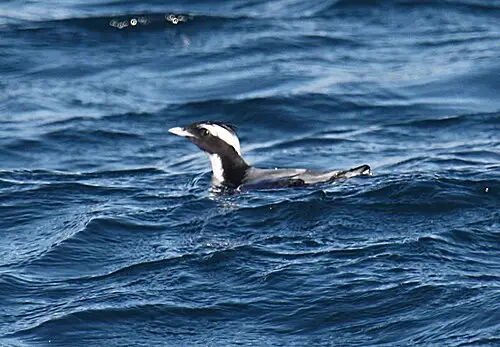
 📸 Photo
Photo: Alastair Rae from London, United Kingdom · CC BY-SA 2.0 · Wikimedia Commons Source
Japanese Murrelet
Synthliboramphus wumizusume (Japanese Murrelet · カンムリウミスズメ)
🇰🇷 Class II endangered wildlife (Korea) · Natural Monument (Korea) «Japanese Murrelet»
💡 Everyday Comparisons for Size, Mass & Speed
- 💡 Its total length of about 26 cm is shorter than two mobile phones (about 15 cm each) placed end to end (Comparison).
- 💡 Its total length of about 26 cm is about 3 cm shorter than the long side of an A4 sheet of paper (29.7 cm) (Comparison).
Reference standards: coach bus ~12 m, mid-size car ~4.9 m, compact car ~1 t, basketball hoop 3.05 m, credit card 8.56 cm.
📖 1. Overview
The Japanese Murrelet is a small alcid that breeds only on a few remote islands in southern Japan and Korea, and is considered possibly the rarest alcid in the world. It is listed as Vulnerable (VU) by the IUCN.
🦴 2. Anatomy & Morphology
It is a small seabird about 26 cm in total length, and because of its small body size, it expends internal energy rapidly.
🔍 3. Ecology & Behavior
It dives underwater to catch prey in offshore waters where warm currents flow. Threats include rats and cats introduced to breeding islands, shifting prey resources caused by fisheries, and human disturbance at breeding sites.
🇰🇷 4. Connection to Korea
In Korea, it is a Class II endangered wildlife (Korea) and was designated as a Natural Monument (Korea) on March 17, 2005. U.S. Geological Survey accounts note that it breeds at only a few sites in southern Japan and Korea.
📚 Sources & References
- • IUCN Red List VU (2018) — https://www.iucnredlist.org/species/22694899/132580332
- • 멸종위기 야생생물 Ⅱ급 · 천연기념물 «뿔쇠오리» — 국가생물종목록(국립생물자원관) ktsn 120000001810 — https://species.nibr.go.kr/home/mainHome.do?cont_link=009&subMenu=009002&contCd=009002&ktsn=120000001810
- • IUCN Red List category VU — latest assessment at iucnredlist.org
- • Korean protection status: Class II endangered wildlife (Korea) · Natural Monument (Korea) «Japanese Murrelet»
- • doi.org — avilist.v2026
- • iucnredlist.org — 132580332
- • 국가생물종목록(국립생물자원관) ktsn 120000001810 — https://species.nibr.go.kr/home/mainHome.do?cont_link=009&subMenu=009002&contCd=009002&ktsn=120000001810
- • heritage.go.kr — culSelectDetail.do
- • wikidata.org — Q495515
- • commons.wikimedia.org — File:Synthliboramphus wumizusume -Japan-8.jpg
- • sealifebase.se — Synthliboramphus-wumizusume
- • usgs.gov — monitoring-and-conservation-japanese-murrelets-and-related-s
- • Silhouette: PhyloPic — author not recorded · CC0 1.0 (Related taxon silhouette — Miocepphus blowi)
Recorded dimensions are widely cited representative estimates from public literature and may vary by study or specimen.