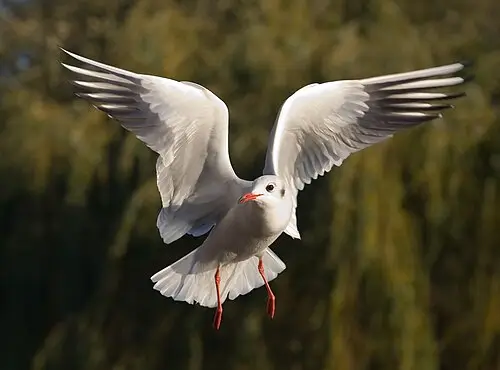
 📸 Photo
Photo: Diliff · CC BY-SA 3.0 · Wikimedia Commons Source
Black-headed Gull
Chroicocephalus ridibundus (Black-headed Gull · ユリカモメ)
💡 Everyday Comparisons for Size, Mass & Speed
- 💡 Its maximum wingspan of 1.1 m is slightly longer than one long umbrella (about 1 m) (Comparison).
- 💡 In western Europe it eats large amounts of human-discarded trash and is commonly seen near canals and sewage treatment facilities (Animal Diversity Web).
- 💡 Because its head is dark like a hood in the breeding season but turns white in winter, it looks different from season to season (Animal Diversity Web).
Reference standards: coach bus ~12 m, mid-size car ~4.9 m, compact car ~1 t, basketball hoop 3.05 m, credit card 8.56 cm.
Site-computed relative index from recorded values; not a formal scientific metric.
📖 1. Overview
The black-headed gull is a small gull that looks as if it is wearing a dark brown to blackish-grey hood during the breeding season. Across temperate Eurasia, it favors shallow waters in lowland areas.
🦴 2. Anatomy & Morphology
In breeding plumage, its head is dark brown to blackish-grey, its underparts and tail are white, and its wings and back are grey. Its bill and legs are red, and in winter its head turns white with only a dark spot remaining behind the eye and neck.
🔍 3. Ecology & Behavior
It mainly eats insects, earthworms, and marine invertebrates, along with fish and grain. It snatches food from the water surface while swimming or dips its head underwater, and in western Europe it also relies heavily on human refuse.
🇰🇷 4. Connection to Korea
No direct record connecting this species to Korea has been found.
📚 Sources & References
- • IUCN Red List category LC — latest assessment at iucnredlist.org
- • doi.org — avilist.v2026
- • iucnredlist.org — 22694420
- • 국가생물종목록(국립생물자원관) ktsn 120000528809 — https://species.nibr.go.kr/home/mainHome.do?cont_link=009&subMenu=009002&contCd=009002&ktsn=120000528809
- • wikidata.org — Q25634
- • commons.wikimedia.org — File:Black-headed Gull - St James's Park, London - Nov 2006.
- • animaldiversity.org — Larus ridibundus
- • Silhouette: PhyloPic — Hans Hillewaert · CC BY 4.0
Recorded dimensions are widely cited representative estimates from public literature and may vary by study or specimen.