 📸 Photo
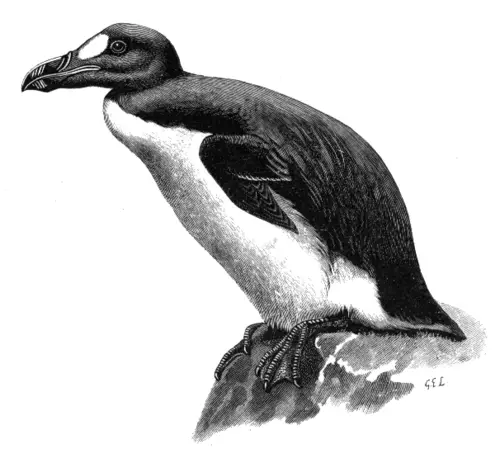
Photo: George Edward Lodge · Public domain · Wikimedia Commons Source
Great Auk
Pinguinus impennis (Great Auk · オオウミガラス)
💡 Everyday Comparisons for Size, Mass & Speed
- 💡 Its maximum weight of 5 kg is the same as a 5 kg bag of rice (Comparison).
- 💡 Bones of this bird are commonly found in ancient coastal middens in Europe and the Mediterranean, showing that humans hunted and ate it since long ago (Animal Diversity Web).
- 💡 Mariners slaughtered it heavily for fresh meat and fuel, rendering its fat for use as fuel (Animal Diversity Web).
Reference standards: coach bus ~12 m, mid-size car ~4.9 m, compact car ~1 t, basketball hoop 3.05 m, credit card 8.56 cm.
Site-computed relative index from recorded values; not a formal scientific metric.
📖 1. Overview
The Great Auk was a large flightless seabird that lived in the North Atlantic and is now extinct. It was regarded as the North Atlantic counterpart to Antarctic penguins.
🦴 2. Anatomy & Morphology
Its back was black, its breast and belly were white, and it had a large white patch in front of each eye. Its wings were greatly reduced, rendering it flightless, and its bill was stout and grooved.
🔍 3. Ecology & Behavior
It was a specialized hunter that dove for fish and appears to have eaten fish around 14–19 cm long in shallow waters. It bred in colonies on rocky islands in May–June.
🇰🇷 4. Connection to Korea
No direct record connecting this species to Korea has been found.
📚 Sources & References
- • IUCN Red List EX (2021) — https://www.iucnredlist.org/species/22694856/205919631
- • IUCN Red List category EX — latest assessment at iucnredlist.org
- • doi.org — avilist.v2026
- • iucnredlist.org — 205919631
- • wikidata.org — Q189193
- • commons.wikimedia.org — File:Alca impennisAMF064LB.png
- • animaldiversity.org — Pinguinus impennis
- • Silhouette: PhyloPic — John James Audubon (Modified) · Public Domain Mark 1.0
Recorded dimensions are widely cited representative estimates from public literature and may vary by study or specimen.