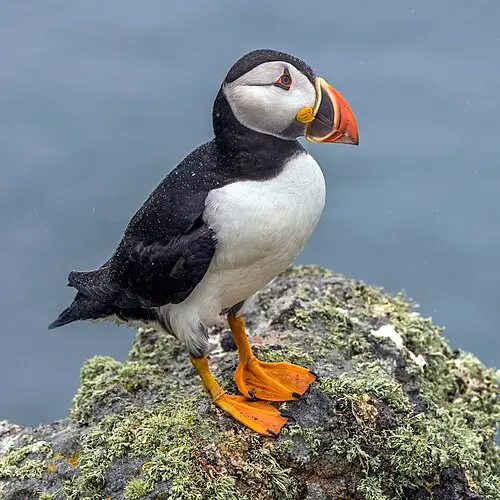
 📸 Photo
Photo: Charles J. Sharp · CC BY-SA 4.0 · Wikimedia Commons Source
Atlantic Puffin
Fratercula arctica (Atlantic Puffin · ニシツノメドリ)
💡 Everyday Comparisons for Size, Mass & Speed
- 💡 Its average weight of 500 g is similar to a 500 mL bottle of water (Comparison).
- 💡 In late summer, many birdwatching tourists visit the state of Maine in the United States to see this bird (Animal Diversity Web).
- 💡 In the past, coastal residents caught nestlings for food, but today the species is studied for ecotourism and as a bioindicator of climate change (Animal Diversity Web).
Reference standards: coach bus ~12 m, mid-size car ~4.9 m, compact car ~1 t, basketball hoop 3.05 m, credit card 8.56 cm.
Site-computed relative index from recorded values; not a formal scientific metric.
📖 1. Overview
The Atlantic Puffin is a seabird notable for its large yellow, red, and orange beak. It spends most of its time at sea in the North Atlantic and comes ashore on coastal cliffs only during the summer breeding season.
🦴 2. Anatomy & Morphology
Its back is black and its chest is white, and its feathers have a waxy coating that repels water. The upper jaw has saw-like grooves that allow it to hold many fish at once.
🔍 3. Ecology & Behavior
It feeds on small marine fish such as capelin, sand lance, and herring, holding about 12 small fish in its beak at a time. It breeds in late spring and stays with the same mate for life.
🇰🇷 4. Connection to Korea
No direct record connecting this species to Korea has been found.
📚 Sources & References
- • IUCN Red List VU (2018) — https://www.iucnredlist.org/species/22694927/132581443
- • IUCN Red List category VU — latest assessment at iucnredlist.org
- • doi.org — avilist.v2026
- • iucnredlist.org — 132581443
- • wikidata.org — Q26685
- • commons.wikimedia.org — File:Puffin (Fratercula arctica).jpg
- • animaldiversity.org — Fratercula arctica
- • Silhouette: PhyloPic — Ferran Sayol · CC0 1.0
Recorded dimensions are widely cited representative estimates from public literature and may vary by study or specimen.