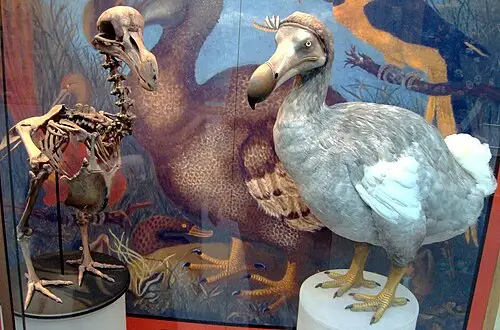
 📸 Photo
Photo: BazzaDaRambler · CC BY 2.0 · Wikimedia Commons Source
Dodo
Raphus cucullatus (Dodo · ドードー)
💡 Everyday Comparisons for Size, Mass & Speed
- 💡 Its estimated maximum weight of 23 kg is slightly heavier than a 20 kg bag of rice (Comparison).
- 💡 Sailors caught up to 50 birds at a time for food and salted them down, and some were brought alive to Europe to be displayed in cages.
Reference standards: coach bus ~12 m, mid-size car ~4.9 m, compact car ~1 t, basketball hoop 3.05 m, credit card 8.56 cm.
Site-computed relative index from recorded values; not a formal scientific metric.
📖 1. Overview
The Dodo was a large, flightless pigeon-family bird that lived in the forests of Mauritius in the Indian Ocean and disappeared after humans arrived on the island (Extinct, EX).
🦴 2. Anatomy & Morphology
Because no complete stuffed specimen exists, its appearance is reconstructed from sailors' accounts and drawings and from fossils, a foot, and a beak preserved at the British Museum and Oxford. Its large bill could reportedly deliver a 'fearsome bite' when threatened.
🔍 3. Ecology & Behavior
It is said to have built its nest on grass on the forest floor, laying and tending a single egg. Sailors' accounts mention that it swallowed stones, which are surmised to have aided digestion, though most ideas about its diet remain conjecture.
🇰🇷 4. Connection to Korea
No direct record connecting this species to Korea has been found.
📚 Sources & References
- • IUCN Red List EX (2024) — https://www.iucnredlist.org/species/22690059/261916273
- • IUCN Red List category EX — latest assessment at iucnredlist.org
- • doi.org — avilist.v2026
- • iucnredlist.org — 261916273
- • wikidata.org — Q43502
- • commons.wikimedia.org — File:Oxford Dodo display.jpg
- • animaldiversity.org — Raphus cucullatus
- • Silhouette: PhyloPic — Steven Traver · CC0 1.0
Recorded dimensions are widely cited representative estimates from public literature and may vary by study or specimen.