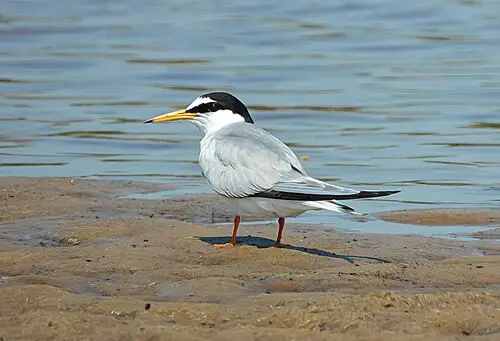
 📸 Photo
Photo: PetroKaterynych · CC BY 4.0 · Wikimedia Commons Source
Little Tern
Sternula albifrons (Little Tern · コアジサシ)
💡 Everyday Comparisons for Size, Mass & Speed
- 💡 Its maximum weight of 63 g is similar to one chicken egg (about 60 g) (Comparison).
- 💡 Andong City in Gyeongsangbuk-do and civic groups built an artificial sand island in Andongho Lake to provide a breeding ground (National Institute of Ecology).
- 💡 Shrinking coastal dunes and ongoing river dredging have reduced sandy nesting grounds, which is cited as a cause of population decline (National Institute of Ecology).
Reference standards: coach bus ~12 m, mid-size car ~4.9 m, compact car ~1 t, basketball hoop 3.05 m, credit card 8.56 cm.
Site-computed relative index from recorded values; not a formal scientific metric.
📖 1. Overview
The Little Tern is the smallest of the terns that visit Korea. It breeds in colonies on sandy and gravelly flats.
🦴 2. Anatomy & Morphology
Its forehead is white, its crown and hindneck are black, and its scapulars, back, and rump are pale gray. Its bill is yellow with a black tip, and its legs are orangish-yellow.
🔍 3. Ecology & Behavior
It catches mainly fish and also eats crustaceans, insects, and mollusks. From late April to July, it lays 2–3 eggs in a shallow scrape on the ground and incubates them for 21–24 days; when a predator approaches, the flock takes flight all at once in communal defense.
🇰🇷 4. Connection to Korea
From spring to autumn it can be seen on sandy islands in rivers, coasts, and estuaries across Korea, with breeding records at Yubudo, Asan Bay, Sihwaho Lake, the Nakdonggang Estuary, and Andongho Lake. At Andongho Lake, an artificial sand island was created as a breeding site.
📚 Sources & References
- • IUCN Red List LC (2019) — https://www.iucnredlist.org/species/22694656/155476219
- • IUCN Red List category LC — latest assessment at iucnredlist.org
- • doi.org — avilist.v2026
- • iucnredlist.org — 155476219
- • 국가생물종목록(국립생물자원관) ktsn 120000528812 — https://species.nibr.go.kr/home/mainHome.do?cont_link=009&subMenu=009002&contCd=009002&ktsn=120000528812
- • wikidata.org — Q12267692
- • commons.wikimedia.org — File:Крячок малий.jpg
- • nie.re.kr — view.do
- • Silhouette: PhyloPic — Sue Cantan (photograph) and T. Michael Keesey (vectorization) · CC BY 4.0 (Related taxon silhouette — Creagrus furcatus)
Recorded dimensions are widely cited representative estimates from public literature and may vary by study or specimen.