 📸 Photo
Photo: Ontley · CC BY-SA 3.0 · Wikimedia Commons Source
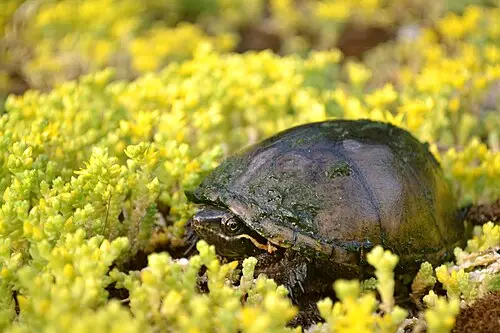
Common Musk Turtle
Sternotherus odoratus (Common Musk Turtle · ミシシッピニオイガメ)
💡 Everyday Comparisons for Size, Mass & Speed
- 💡 An average weight of 100 g is the weight of one or two chicken eggs, and a maximum length of 12.7 cm is about 1.5 times the long side of a credit card (about 8.6 cm) (Comparison).
- 💡 Although occasionally eaten by people, it is mainly kept as a pet (positive impacts on humans in ADW).
Reference standards: coach bus ~12 m, mid-size car ~4.9 m, compact car ~1 t, basketball hoop 3.05 m, credit card 8.56 cm.
Site-computed relative index from recorded values; not a formal scientific metric.
📖 1. Overview
The Common Musk Turtle is a small freshwater turtle living in ponds, lakes, and swamps of North America that rarely strays far from water except when females lay eggs. Its IUCN assessment is Least Concern (LC) as of 2025.
🦴 2. Anatomy & Morphology
Its brown carapace is elongated and narrow with irregular black streaks or spots, and each side of the head bears a pair of yellow stripes above and below the eye. Its snout is long and pointed, and its plastron is small and yellow.
🔍 3. Ecology & Behavior
It is an omnivore that eats aquatic plants, seeds, insects, mollusks, crayfish, earthworms, and even dead fish. Because it spends most of its time walking along the bottom in search of food, it is nicknamed the 'bottom walker,' and it lays 1–4 clutches a year with 1–6 eggs per clutch.
🇰🇷 4. Connection to Korea
No direct record connecting this species to Korea has been found.
📚 Sources & References
- • IUCN Red List LC (2025) — https://www.iucnredlist.org/species/163450/161721733
- • IUCN Red List category LC — latest assessment at iucnredlist.org
- • catalogueoflife.org — 52FT3
- • iucnredlist.org — 161721733
- • wikidata.org — Q674891
- • commons.wikimedia.org — File:Stinkpot Turtle.jpg
- • animaldiversity.org — Sternotherus odoratus
- • Silhouette: PhyloPic — Bibron, Gabriel; Duméril, Auguste Henri André; Duméril, C. · Public Domain Mark 1.0
Recorded dimensions are widely cited representative estimates from public literature and may vary by study or specimen.