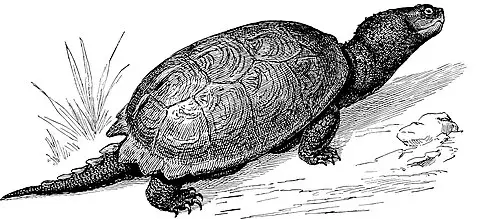
 📸 Photo
Photo: Edward Knobel · Public domain · Wikimedia Commons Source
Common Snapping Turtle
Chelydra serpentina (Common Snapping Turtle · カミツキガメ)
💡 Everyday Comparisons for Size, Mass & Speed
- 💡 A maximum carapace length of 45 cm is about 1.5 times the long side of an A4 sheet (about 30 cm), and a maximum mass of 16 kg is about 4/5 of a 20 kg bag of rice (Comparison).
- 💡 In the United States it is used as an ingredient in turtle stews and soups, and dried shells were made into ceremonial rattles by Native Americans (benefit to humans noted by ADW).
Reference standards: coach bus ~12 m, mid-size car ~4.9 m, compact car ~1 t, basketball hoop 3.05 m, credit card 8.56 cm.
Site-computed relative index from recorded values; not a formal scientific metric.
📖 1. Overview
The Common Snapping Turtle is a large turtle inhabiting fresh and brackish waters of North America, preferring muddy bottoms with abundant aquatic vegetation. Its IUCN status is Least Concern (LC) as of 2025.
🦴 2. Anatomy & Morphology
Its carapace is 20–45 cm long, and its tail is nearly as long as the carapace and bears saw-toothed ridges. The plastron is very small, leaving the limbs largely exposed, and its neck and legs are covered with tubercles.
🔍 3. Ecology & Behavior
An omnivore that eats carrion, invertebrates, fish, birds, small mammals, amphibians, and a large amount of aquatic plants. Solitary by nature, it buries itself in mud with only its nostrils and eyes exposed to ambush prey, and lays up to 83 eggs in a clutch.
🇰🇷 4. Connection to Korea
No direct record connecting this species to Korea has been found.
📚 Sources & References
- • IUCN Red List LC (2025) — https://www.iucnredlist.org/species/163424/251347989
- • IUCN Red List category LC — latest assessment at iucnredlist.org
- • catalogueoflife.org — TWRZ
- • iucnredlist.org — 251347989
- • wikidata.org — Q289435
- • commons.wikimedia.org — File:Snapping Turtle-TSF 0009.jpg
- • animaldiversity.org — Chelydra serpentina
- • Silhouette: PhyloPic — Beth Reinke · CC0 1.0
Recorded dimensions are widely cited representative estimates from public literature and may vary by study or specimen.