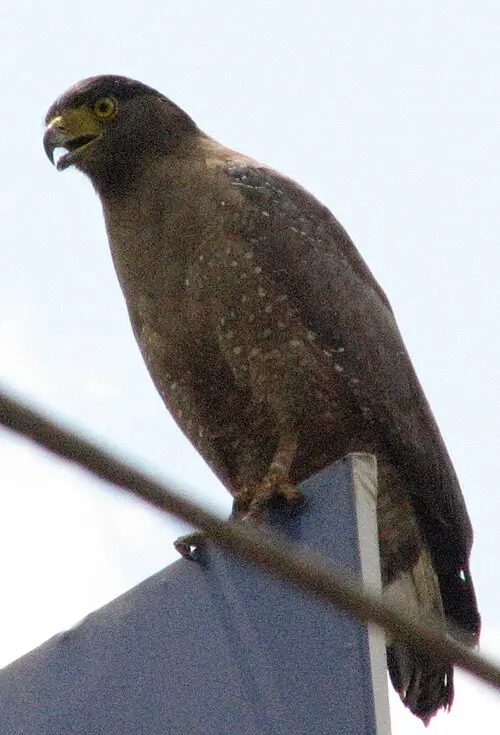
 📸 Photo
Photo: Preveen at English Wikipedia · CC BY 2.5 · Wikimedia Commons Source
Crested Serpent Eagle
Spilornis cheela (Crested Serpent Eagle · カンムリワシ)
💡 Everyday Comparisons for Size, Mass & Speed
- 💡 Its wingspan of 1.69 m is almost the same as the height of an adult human (about 1.7 m) (Comparison).
- 💡 According to ADW, it catches many snakes harmful to humans as well as rodents that gnaw on farm crops.
Reference standards: coach bus ~12 m, mid-size car ~4.9 m, compact car ~1 t, basketball hoop 3.05 m, credit card 8.56 cm.
Site-computed relative index from recorded values; not a formal scientific metric.
📖 1. Overview
The Crested Serpent Eagle is a medium-sized eagle living in subtropical and tropical Asia, named for its habit of hunting mainly snakes. It hunts by soaring from forest edges.
🦴 2. Anatomy & Morphology
When perched, it is dark brown with an almost black hood over the head and neck, and its black crest stands out when raised. In flight, a single broad pale band shows across the wings and tail, and its legs and the skin around its eyes are yellow.
🔍 3. Ecology & Behavior
It preys mainly on snakes, hunting venomous as well as non-venomous species, and also eats small mammals, monkeys, and birds. Pairs stay together year-round and build their nests in tall trees near water.
🇰🇷 4. Connection to Korea
No direct record connecting this species to Korea has been found.
📚 Sources & References
- • IUCN Red List LC (2025) — https://www.iucnredlist.org/species/22695293/280933280
- • IUCN Red List category LC — latest assessment at iucnredlist.org
- • doi.org — avilist.v2026
- • iucnredlist.org — 280933280
- • 국가생물종목록(국립생물자원관) ktsn 120000001596 — https://species.nibr.go.kr/home/mainHome.do?cont_link=009&subMenu=009002&contCd=009002&ktsn=120000001596
- • wikidata.org — Q431212
- • commons.wikimedia.org — File:Crested Sperpent Eagle 1.jpg
- • animaldiversity.org — Spilornis cheela
- • species.nibr.go.kr — mainHome.do
- • Silhouette: PhyloPic — Robert Cooke · CC0 1.0 (Related taxon silhouette — Accipitridae)
Recorded dimensions are widely cited representative estimates from public literature and may vary by study or specimen.