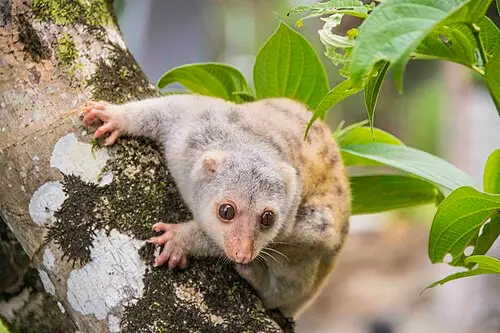
 📸 Photo
Photo: garywwilson · CC BY 4.0 · Wikimedia Commons Source
Common Spotted Cuscus
Spilocuscus maculatus (Common Spotted Cuscus · ブチクスクス)
💡 Everyday Comparisons for Size, Mass & Speed
- 💡 Its maximum weight of 6 kg is about 6 tenths of a 10 kg bag of rice, and its maximum body length of 58 cm is about 2 times the long side of an A4 sheet of paper (29.7 cm) (Comparison).
- 💡 In New Guinea it is hunted for food and for making clothing, bags, and hats, as well as for ceremonies such as birthdays, childbirths, and initiations.
Reference standards: coach bus ~12 m, mid-size car ~4.9 m, compact car ~1 t, basketball hoop 3.05 m, credit card 8.56 cm.
Site-computed relative index from recorded values; not a formal scientific metric.
📖 1. Overview
The Common Spotted Cuscus is a medium-sized arboreal marsupial living in the tropical forests of New Guinea and northern Australia.
🦴 2. Anatomy & Morphology
It weighs 3–6 kg, with males larger than females. Its long prehensile tail lacks fur and has rough tubercles on the underside.
🔍 3. Ecology & Behavior
It feeds mainly on young leaves and shoots, occasionally eating young coconuts, insects, and small vertebrates. Active at dusk, it sleeps among canopy foliage during the day and has a low reproductive rate, breeding usually once a year.
🇰🇷 4. Connection to Korea
No direct record connecting this species to Korea has been found.
📚 Sources & References
- • IUCN Red List LC (2016) — https://www.iucnredlist.org/species/20636/21950307
- • IUCN Red List category LC — latest assessment at iucnredlist.org
- • mammaldiversity.org — 1000394
- • iucnredlist.org — 21950307
- • wikidata.org — Q209548
- • commons.wikimedia.org — File:Spilocuscus maculatus 108965421.jpg
- • animaldiversity.org — Spilocuscus maculatus
- • Silhouette: PhyloPic — Kawinwit Kittipalawattanapol · CC0 1.0 (Related taxon silhouette — Trichosurus vulpecula)
Recorded dimensions are widely cited representative estimates from public literature and may vary by study or specimen.