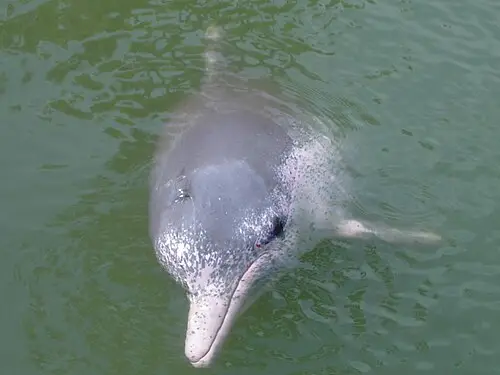
 📸 Photo
Photo: user:takoradee · CC BY 2.5 · Wikimedia Commons Source
Indo-Pacific Humpback Dolphin
Sousa chinensis (Indo-Pacific Humpback Dolphin · シナウスイロイルカ)
💡 Everyday Comparisons for Size, Mass & Speed
- 💡 Its maximum weight of 280 kg equals the weight of fourteen 20 kg bags of rice (Comparison).
- 💡 Because captive individuals suffer high mortality rates, it is rarely kept in aquariums.
Reference standards: coach bus ~12 m, mid-size car ~4.9 m, compact car ~1 t, basketball hoop 3.05 m, credit card 8.56 cm.
Site-computed relative index from recorded values; not a formal scientific metric.
📖 1. Overview
The Indo-Pacific Humpback Dolphin is a medium-sized dolphin of warm shallow coastal waters and large river estuaries, named for the hump-like ridge on its back.
🦴 2. Anatomy & Morphology
It has a robust body, a long beak, and a dorsal fin sitting atop a wide hump whose shape varies by region. The Taiwanese subspecies is dark gray when young and turns pinkish white as an adult.
🔍 3. Ecology & Behavior
It feeds near the bottom mainly on estuarine and reef fishes, and also eats squid and crustaceans. It usually travels in small groups of around 10 individuals, while larger groups gather behind trawlers.
🇰🇷 4. Connection to Korea
No direct record connecting this species to Korea has been found.
📚 Sources & References
- • IUCN Red List VU (2017) — https://www.iucnredlist.org/species/82031425/123794774
- • IUCN Red List category VU — latest assessment at iucnredlist.org
- • mammaldiversity.org — 1006432
- • iucnredlist.org — 123794774
- • wikidata.org — Q713853
- • commons.wikimedia.org — File:Pink Dolphin.JPG
- • animaldiversity.org — Sousa chinensis
- • fisheries.noaa.gov — indo-pacific-humpback-dolphin
- • Silhouette: PhyloPic — author not recorded · CC0 1.0
Recorded dimensions are widely cited representative estimates from public literature and may vary by study or specimen.