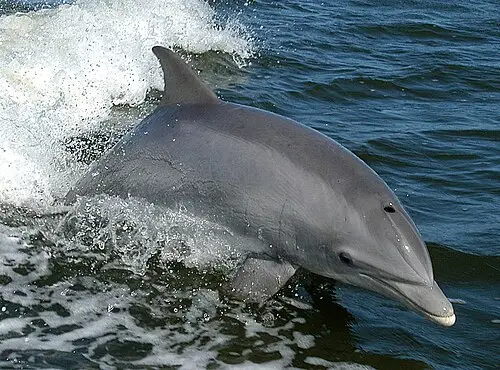
 📸 Photo
Photo: NASA · Public domain · Wikimedia Commons Source
Common Bottlenose Dolphin
Tursiops truncatus (Common Bottlenose Dolphin · ハンドウイルカ)
🇰🇷 Marine Protected Species (Korea)
💡 Everyday Comparisons for Size, Mass & Speed
- 💡 Its maximum body length of about 4 m is slightly shorter than the length of one passenger car (about 4.5 m) (Comparison).
- 💡 Its maximum weight of about 635 kg is about the weight of ten adults (about 60 kg each) (Comparison).
Reference standards: coach bus ~12 m, mid-size car ~4.9 m, compact car ~1 t, basketball hoop 3.05 m, credit card 8.56 cm.
Site-computed relative index from recorded values; not a formal scientific metric.
📖 1. Overview
The Common Bottlenose Dolphin is an intelligent dolphin living in harbors, coastal waters, and open seas across temperate and tropical oceans worldwide.
🦴 2. Anatomy & Morphology
True to its name, it has a short, stout snout, and its body is mostly gray with a paler belly. Coastal individuals tend to be smaller and lighter in color than offshore individuals.
🔍 3. Ecology & Behavior
It eats fish, squid, and crustaceans such as crabs and shrimp, swallowing fish headfirst so spines do not catch in its throat. It communicates with sounds, locates prey by echolocation, and herds schools of fish while taking turns rushing in.
🇰🇷 4. Connection to Korea
It is listed in the National List of Species of Korea (National Institute of Biological Resources (NIBR)) as "keundolgorae" (Korean name), and in August 2021 (month 8) the Ministry of Oceans and Fisheries issued a press release announcing that the Common Bottlenose Dolphin would also be protected as a Marine Protected Species.
📚 Sources & References
- • IUCN Red List LC (2019) — https://www.iucnredlist.org/species/22563/156932432
- • 해양보호생물 — 국가생물종목록(국립생물자원관) ktsn 120000053400 — https://species.nibr.go.kr/home/mainHome.do?cont_link=009&subMenu=009002&contCd=009002&ktsn=120000053400
- • IUCN Red List category LC — latest assessment at iucnredlist.org
- • Korean protection status: Marine Protected Species (Korea)
- • mammaldiversity.org — 1006443
- • iucnredlist.org — 156932432
- • 국가생물종목록(국립생물자원관) ktsn 120000053400 — https://species.nibr.go.kr/home/mainHome.do?cont_link=009&subMenu=009002&contCd=009002&ktsn=120000053400
- • wikidata.org — Q174199
- • commons.wikimedia.org — File:Tursiops truncatus 01-cropped.jpg
- • fisheries.noaa.gov — common-bottlenose-dolphin
- • korea.kr — pressReleaseView.do
- • species.nibr.go.kr — general-search
- • Silhouette: PhyloPic — author not recorded · CC0 1.0
Recorded dimensions are widely cited representative estimates from public literature and may vary by study or specimen.