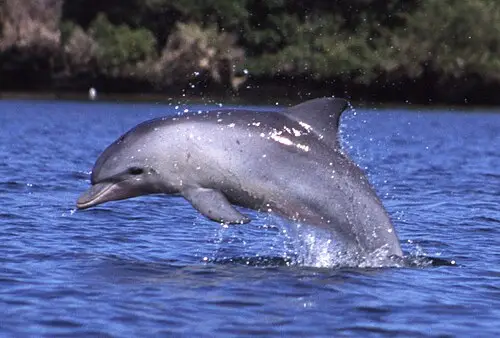
 📸 Photo
Photo: Aude Steiner · CC BY-SA 1.0 · Wikimedia Commons Source
Indo-Pacific Bottlenose Dolphin
Tursiops aduncus (Indo-Pacific Bottlenose Dolphin · ミナミハンドウイルカ)
🇰🇷 Marine Protected Species (Korea)
💡 Everyday Comparisons for Size, Mass & Speed
- 💡 Its average weight of about 230 kg is close to the weight of four adults (about 60 kg each) (Comparison).
- 💡 Following its designation in 2012, the Jeju Indo-Pacific Bottlenose Dolphin can no longer be captured for commercial purposes such as dolphin shows.
Reference standards: coach bus ~12 m, mid-size car ~4.9 m, compact car ~1 t, basketball hoop 3.05 m, credit card 8.56 cm.
Site-computed relative index from recorded values; not a formal scientific metric.
📖 1. Overview
The Indo-Pacific Bottlenose Dolphin lives in shallow coastal waters of the Indian and western Pacific Oceans and has a smaller body and a longer, more slender snout than the Common Bottlenose Dolphin.
🦴 2. Anatomy & Morphology
Compared to the Common Bottlenose Dolphin, its body and head are smaller and its flippers are larger; its back is dark bluish gray and its belly is sometimes pale pink. Its conical teeth number 20–28 on each side of the jaw.
🔍 3. Ecology & Behavior
It mainly eats bony fish and squid, and in shallow water it may kick fish onto the sand with its tail or herd small fish toward shore. It usually travels in groups of 5–15, and females give birth once every 4–6 years.
🇰🇷 4. Connection to Korea
It is listed in the National List of Species of Korea (National Institute of Biological Resources (NIBR)) as "nambang-keundolgorae" (Korean name), and in October 2012 (month 10) the Jeju Indo-Pacific Bottlenose Dolphin was designated as a Marine Organism under Protection under the Enforcement Rule of the Conservation and Management of Marine Ecosystems Act, prohibiting capture for commercial purposes such as shows.
📚 Sources & References
- • IUCN Red List NT (2019) — https://www.iucnredlist.org/species/41714/50381127
- • 해양보호생물 — 국가생물종목록(국립생물자원관) ktsn 120000209302 — https://species.nibr.go.kr/home/mainHome.do?cont_link=009&subMenu=009002&contCd=009002&ktsn=120000209302
- • IUCN Red List category NT — latest assessment at iucnredlist.org
- • Korean protection status: Marine Protected Species (Korea)
- • mammaldiversity.org — 1006442
- • iucnredlist.org — 50381127
- • 국가생물종목록(국립생물자원관) ktsn 120000209302 — https://species.nibr.go.kr/home/mainHome.do?cont_link=009&subMenu=009002&contCd=009002&ktsn=120000209302
- • wikidata.org — Q370597
- • commons.wikimedia.org — File:Tursiops aduncus, Port River, Adelaide, Australia - 200
- • animaldiversity.org — Tursiops aduncus
- • korea.kr — policyBriefingView.do
- • species.nibr.go.kr — general-search
- • Silhouette: PhyloPic — author not recorded · CC0 1.0
Recorded dimensions are widely cited representative estimates from public literature and may vary by study or specimen.