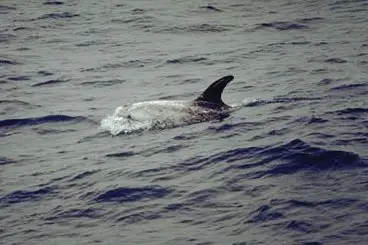
 📸 Photo
Photo: National Marine Mammal Laboratory, no individual author credit given · Public domain · Wikimedia Commons Source
Risso's Dolphin
Grampus griseus (Risso's Dolphin · ハナゴンドウ)
💡 Everyday Comparisons for Size, Mass & Speed
- 💡 It is occasionally taken in Japan for food and fertilizer, and hunted in Indonesia and the Caribbean for meat and oil.
- 💡 Its maximum body length of 4 m is similar to the length of a passenger car (about 4.5 m) (Comparison).
Reference standards: coach bus ~12 m, mid-size car ~4.9 m, compact car ~1 t, basketball hoop 3.05 m, credit card 8.56 cm.
Site-computed relative index from recorded values; not a formal scientific metric.
📖 1. Overview
Risso's Dolphin is a medium-sized dolphin distributed across the world's oceans, easily recognized by the many white scars covering its body.
🦴 2. Anatomy & Morphology
It has a rounded head with no distinct beak, a tall sickle-shaped dorsal fin, and long flippers. Its body is covered in white scratch marks, most of them bite scars from squid, and it has only 2–7 pairs of teeth at the front of the lower jaw.
🔍 3. Ecology & Behavior
It feeds mainly on squid along with crustaceans and fish, sometimes foraging at depths of 600–800 m, and forms a stratified society grouped by age and sex.
🇰🇷 4. Connection to Korea
It is listed as 'Keunmeori-dolgorae' (Korean name) on the National List of Species of Korea and may occur throughout Korean waters.
📚 Sources & References
- • IUCN Red List LC (2025) — https://www.iucnredlist.org/species/9461/247625936
- • IUCN Red List category LC — latest assessment at iucnredlist.org
- • mammaldiversity.org — 1006415
- • iucnredlist.org — 247625936
- • 국가생물종목록(국립생물자원관) ktsn 120000053382 — https://species.nibr.go.kr/home/mainHome.do?cont_link=009&subMenu=009002&contCd=009002&ktsn=120000053382
- • wikidata.org — Q203897
- • commons.wikimedia.org — File:Rundkopfdelfin.jpg
- • animaldiversity.org — Grampus griseus
- • species.nibr.go.kr — mainHome.do
- • Silhouette: PhyloPic — Chris Forbes · CC BY 4.0 (Congeneric silhouette — Orcinus)
Recorded dimensions are widely cited representative estimates from public literature and may vary by study or specimen.