 📸 Photo
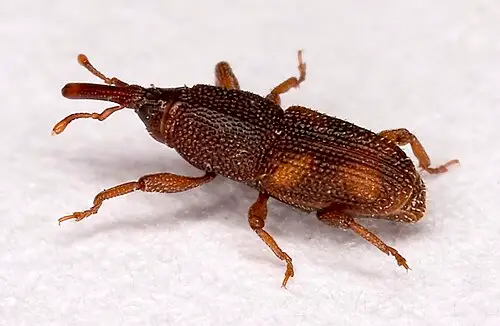
Photo: picture taken by Olaf Leillinger · CC BY-SA 2.5 · Wikimedia Commons Source
Rice weevil
Sitophilus oryzae (Rice weevil · Rice weevil)
Not Evaluated (NE) on the IUCN Red List yet.
💡 Everyday Comparisons for Size, Mass & Speed
- 💡 This is the tiny bug often found inside household rice jars or rice bags. Korea's Rural Development Administration recommends keeping rice in an airtight container in the refrigerator.
- 💡 Its maximum body length of 3.5 mm is about 1/5 the diameter of a Korean 10-won coin (18 mm) (Comparison).
Reference standards: coach bus ~12 m, mid-size car ~4.9 m, compact car ~1 t, basketball hoop 3.05 m, credit card 8.56 cm.
📖 1. Overview
The rice weevil is a small weevil that develops inside cereal grains such as rice and wheat, and is a major pest of stored grain. It is distributed worldwide.
🦴 2. Anatomy & Morphology
It is 2.5–3.5 mm in body length and dark reddish-brown, with mandibles at the tip of a long snout and two pale markings on each forewing. Its wings are well developed, allowing it to fly and disperse.
🔍 3. Ecology & Behavior
The female lays 300–400 eggs, and the egg, larval, and pupal stages are spent inside the grain kernel, making them hard to see from the outside. A life cycle can be completed in as little as 32 days, and adults live for 3–6 months.
🇰🇷 4. Connection to Korea
In a survey of stored rice in the Jeollanam-do region, the rice weevil went through 4 generations per year and appeared in the highest numbers from late July to late August. Korea's Rural Development Administration advises storing rice sealed in a cool, dry place or in a refrigerator, as pests can develop in rice during hot and humid summers.
📚 Sources & References
- • IUCN Red List: not evaluated (NE) — cross-checked with the Wikidata conservation-status entry
- • catalogueoflife.org — 8J73K
- • 국가생물종목록(국립생물자원관) ktsn 120000090601 — https://species.nibr.go.kr/home/mainHome.do?cont_link=009&subMenu=009002&contCd=009002&ktsn=120000090601
- • wikidata.org — Q219224
- • commons.wikimedia.org — File:Sitophilus.oryzae.7438.jpg
- • entnemdept.ufl.edu — rice weevil.htm
- • koreascience.or.kr — JAKO198811920240099.page
- • rda.go.kr — board.do
- • bok.or.kr — contents.do
- • Silhouette: PhyloPic — C. Camilo Julián-Caballero · CC BY 3.0 (Related taxon silhouette — Scyphophorus acupunctatus)
Recorded dimensions are widely cited representative estimates from public literature and may vary by study or specimen.