 📸 Photo
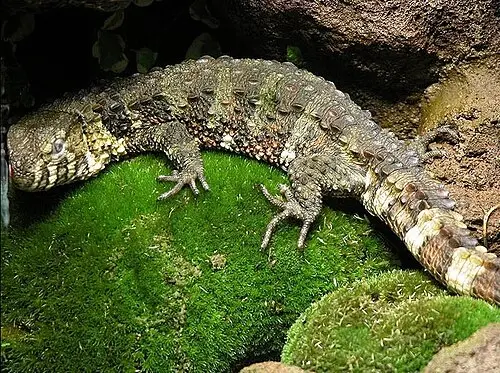
Photo: Wilfried Berns, Aufgenommen mit einer Nikon Coolpix 5700 · CC BY-SA 2.0 de · Wikimedia Commons Source
Chinese Crocodile Lizard
Shinisaurus crocodilurus (Chinese Crocodile Lizard · シナワニトカゲ)
💡 Everyday Comparisons for Size, Mass & Speed
- 💡 At the Smithsonian's National Zoo, it is fed crickets, earthworms, and snails.
- 💡 Because of a belief that it helps cure insomnia, it is collected for traditional medicine and also taken for the pet trade, while captive-bred individuals are rare. International trade is regulated under CITES Appendix II (Smithsonian's National Zoo).
Reference standards: coach bus ~12 m, mid-size car ~4.9 m, compact car ~1 t, basketball hoop 3.05 m, credit card 8.56 cm.
📖 1. Overview
The Chinese Crocodile Lizard is a lizard living by forest ponds and streams in southern China and Vietnam, with rows of scales on its tail that resemble a crocodile.
🦴 2. Anatomy & Morphology
It has a grayish-brown body with a yellowish belly, reddish-orange markings on the throat and flanks, and alternating light and dark bands extending down the tail. Two rigid rows of scales run along the tail, and males are generally larger and more colorful.
🔍 3. Ecology & Behavior
It can dive underwater and stay submerged for a long time to escape predators and hunt. It mainly eats invertebrates such as snails, tadpoles, insects, worms, and larvae, and is viviparous, giving birth to 2–12 live young at a time.
🇰🇷 4. Connection to Korea
No direct record connecting this species to Korea has been found.
📚 Sources & References
- • IUCN Red List EN (2022) — https://www.iucnredlist.org/species/57287221/217811129
- • IUCN Red List category EN — latest assessment at iucnredlist.org
- • catalogueoflife.org — 4X4PH
- • iucnredlist.org — 217811129
- • wikidata.org — Q302215
- • commons.wikimedia.org — File:Chin-krokodilschwanzechse-01.jpg
- • nationalzoo.si.edu — chinese-crocodile-lizard
- • Silhouette: PhyloPic — Jose Carlos Arenas-Monroy · CC0 1.0
Recorded dimensions are widely cited representative estimates from public literature and may vary by study or specimen.