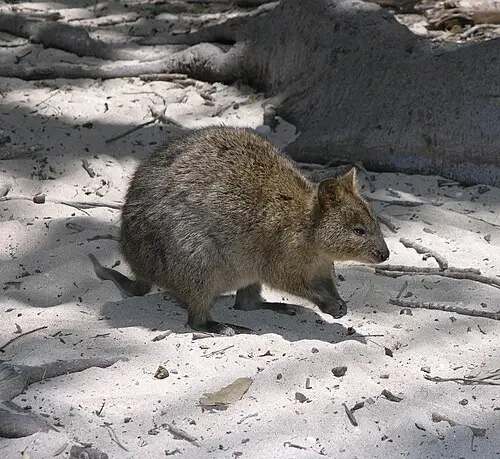
 📸 Photo
Photo: en:User:SeanMack · CC BY-SA 3.0 · Wikimedia Commons Source
Quokka
Setonix brachyurus (Quokka · クアッカワラビー)
💡 Everyday Comparisons for Size, Mass & Speed
- 💡 Its maximum weight of 4.2 kg is slightly heavier than two 2 L bottles of water (4 kg) (Comparison).
- 💡 Friendly toward humans and a favorite subject for photos, it has become a major tourist attraction, though its small population means it cannot be kept as a pet.
Reference standards: coach bus ~12 m, mid-size car ~4.9 m, compact car ~1 t, basketball hoop 3.05 m, credit card 8.56 cm.
Site-computed relative index from recorded values; not a formal scientific metric.
📖 1. Overview
The Quokka is a small wallaby living in southwestern Australia and on Rottnest Island, called "the happiest animal in the world" because its face looks as if it is smiling.
🦴 2. Anatomy & Morphology
It has coarse, bushy brown fur with a paler belly, a small head, a black nose, and round ears. Its back is hunched, its forelimbs are very short, and its hind legs are sturdy.
🔍 3. Ecology & Behavior
Emerging at night to feed on water-rich plants such as succulents, shrubs, and grasses, it does not need to drink much water. It swallows its food, regurgitates it to chew the cud, and can climb trees up to about 1.5 m high.
🇰🇷 4. Connection to Korea
No direct record connecting this species to Korea has been found.
📚 Sources & References
- • IUCN Red List VU (2025) — https://www.iucnredlist.org/species/20165/258663635
- • IUCN Red List category VU — latest assessment at iucnredlist.org
- • mammaldiversity.org — 1000310
- • iucnredlist.org — 258663635
- • wikidata.org — Q726151
- • commons.wikimedia.org — File:Rottnest Quokka 2004 SeanMcClean.jpg
- • animaldiversity.org — Setonix brachyurus
- • Silhouette: PhyloPic — Kawinwit Kittipalawattanapol · CC0 1.0 (Related taxon silhouette — Thylogale billardierii)
Recorded dimensions are widely cited representative estimates from public literature and may vary by study or specimen.