 📸 Photo
Photo: Vyacheslav Argenberg · CC BY 4.0 · Wikimedia Commons Source
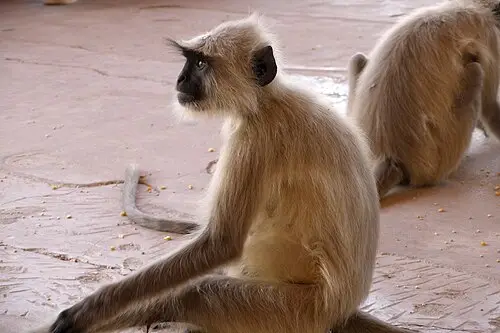
Bengal Sacred Langur
Semnopithecus entellus (Bengal Sacred Langur · ハヌマンラングール)
💡 Everyday Comparisons for Size, Mass & Speed
- 💡 A male weighing about 13 kg equals around six and a half 2 L bottles of water (Comparison).
- 💡 It lives close to people even in cities such as Jodhpur, India, which has a population of over a million.
- 💡 In many parts of India, it is revered as a sacred animal.
Reference standards: coach bus ~12 m, mid-size car ~4.9 m, compact car ~1 t, basketball hoop 3.05 m, credit card 8.56 cm.
Site-computed relative index from recorded values; not a formal scientific metric.
📖 1. Overview
The Bengal Sacred Langur is a leaf-eating monkey of India and neighboring regions that has adapted to a wide range of environments, including living alongside humans.
🦴 2. Anatomy & Morphology
It has brownish-gray fur with a reddish tinge on the back and a white belly; its hands, feet, face, and ears are black, framed by white fur around the face. Its tail is longer than its body and white-tipped.
🔍 3. Ecology & Behavior
More than half of its diet (52–61%) consists of leaves, supplemented by fruits, flowers, insects, bark, and soil, as well as food offered by people. It spends about 80% of its time on the ground and sleeps in trees.
🇰🇷 4. Connection to Korea
No direct record connecting this species to Korea has been found.
📚 Sources & References
- • IUCN Red List LC (2020) — https://www.iucnredlist.org/species/39832/17942050
- • IUCN Red List category LC — latest assessment at iucnredlist.org
- • mammaldiversity.org — 1000688
- • iucnredlist.org — 17942050
- • wikidata.org — Q817180
- • commons.wikimedia.org — File:Monkeys at Amer Fort, India.jpg
- • animaldiversity.org — Semnopithecus entellus
- • Silhouette: PhyloPic — Kai R. Caspar · CC BY 3.0
Recorded dimensions are widely cited representative estimates from public literature and may vary by study or specimen.