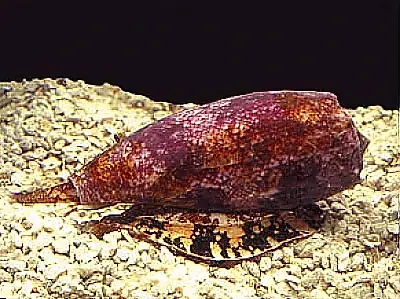
 📸 Photo
Photo: Kerry Matz, National Institute of General Medical Services · Public domain · Wikimedia Commons Source
Geography cone
Conus geographus (Geography cone · アンボイナガイ)
💡 Everyday Comparisons for Size, Mass & Speed
- 💡 Its maximum weight of 62 g is similar to a single chicken egg (about 60 g) (Comparison).
- 💡 Its maximum shell length of 16.6 cm is just under twice the long side of a credit card (about 8.6 cm) (Comparison).
- 💡 A venom component called conantokin (Con-G) is being studied for its potential use as a pain-relieving analgesic (ADW).
Reference standards: coach bus ~12 m, mid-size car ~4.9 m, compact car ~1 t, basketball hoop 3.05 m, credit card 8.56 cm.
Site-computed relative index from recorded values; not a formal scientific metric.
📖 1. Overview
The geography cone is a cone-shaped marine snail that hunts fish with venom on sandy bottoms of tropical coral reefs. It possesses potent venom.
🦴 2. Anatomy & Morphology
Its shell is a smooth cone with brown or red mottled patterns arranged in rows over a white, cream, or pink ground. Its body extends a long proboscis out of the shell to sting prey.
🔍 3. Ecology & Behavior
It stays buried in sand during the day and comes out at night to hunt fish while they rest. It uses two hunting methods: a 'hook-and-line' method, waving its proboscis like a lure to draw fish in before stinging them with a radular tooth, and a 'net' method.
🇰🇷 4. Connection to Korea
No direct record connecting this species to Korea has been found.
📚 Sources & References
- • IUCN Red List LC (2026) — https://www.iucnredlist.org/species/192772/251030063
- • IUCN Red List category LC — latest assessment at iucnredlist.org
- • marinespecies.org — aphia.php
- • iucnredlist.org — 251030063
- • wikidata.org — Q1780734
- • commons.wikimedia.org — File:Conus-geographicus.jpg
- • sealifebase.se — Conus-geographus.html
- • animaldiversity.org — Conus geographus
- • Silhouette: PhyloPic — K8otter · Public Domain Mark 1.0
Recorded dimensions are widely cited representative estimates from public literature and may vary by study or specimen.