 📸 Photo
Photo: NOAA/MBARI · CC0 · Wikimedia Commons Source
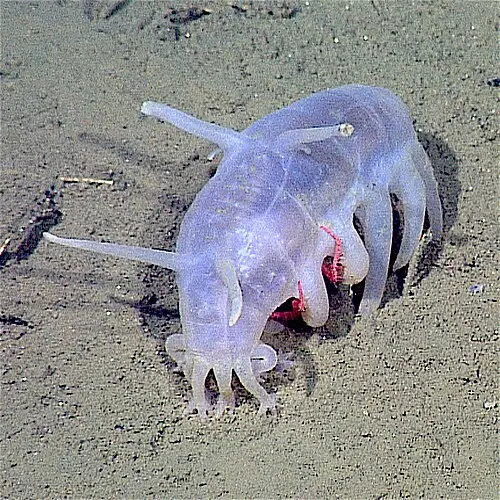
Globose sea pig
Scotoplanes globosa (Globose sea pig · センジュナマコ)
Not Evaluated (NE) on the IUCN Red List yet.
💡 Everyday Comparisons for Size, Mass & Speed
- 💡 The genus maximum size of 17 cm is similar to a new pencil (about 17.5 cm) (Comparison).
- 💡 Its deepest recorded depth of 6,720 m is like stacking Lotte World Tower (height 555 m) about 12 times deep (Comparison).
Reference standards: coach bus ~12 m, mid-size car ~4.9 m, compact car ~1 t, basketball hoop 3.05 m, credit card 8.56 cm.
📖 1. Overview
The globose sea pig is a sea cucumber living on the deep sea floor, recorded off Chile, southwest of the Cape of Good Hope, and in the Southern Ocean.
🦴 2. Anatomy & Morphology
Unlike other sea cucumbers, members of this genus (Scotoplanes) raise their bodies above soft mud on long, pillar-like tube feet. Its translucent body grows up to 17 cm, and sea cucumbers have only a single gonad.
🔍 3. Ecology & Behavior
It roams across deep-sea muddy bottoms feeding on fresh organic detritus. Groups of individuals have also been observed feeding beside sunken whale carcasses. Eggs and sperm meet outside the body.
🇰🇷 4. Connection to Korea
No direct record connecting this species to Korea has been found.
📚 Sources & References
- • IUCN Red List: not evaluated (NE) — cross-checked with the Wikidata conservation-status entry
- • marinespecies.org — aphia.php
- • wikidata.org — Q2490972
- • commons.wikimedia.org — File:Scotoplanes globosa and crab (cropped).jpg
- • mbari.org — sea-pig
- • sealifebase.se — Scotoplanes-globosa.html
- • Silhouette: PhyloPic — Lindberg (vectorized by T. Michael Keesey) · Public Domain Mark 1.0
Recorded dimensions are widely cited representative estimates from public literature and may vary by study or specimen.