 📸 Photo
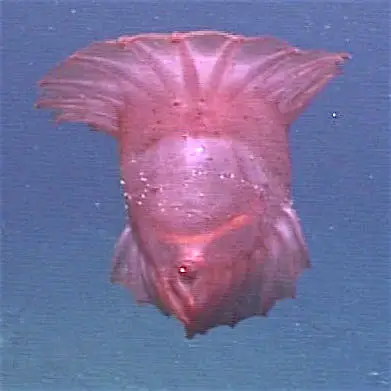
Photo: Image courtesy of Expedition to the Deep Slope 2007. · Public domain · Wikimedia Commons Source
Headless chicken monster
Enypniastes eximia (Headless chicken monster · ユメナマコ)
Not Evaluated (NE) on the IUCN Red List yet.
💡 Everyday Comparisons for Size, Mass & Speed
- 💡 Its deepest recorded depth of 5,689 m is about 10 times the height of Lotte World Tower (555 m).
- 💡 Footage of this sea cucumber filmed in the Gulf of Mexico in 2017 is publicly available on the NOAA Ocean Exploration website for anyone to view (NOAA Ocean Exploration).
Reference standards: coach bus ~12 m, mid-size car ~4.9 m, compact car ~1 t, basketball hoop 3.05 m, credit card 8.56 cm.
📖 1. Overview
The headless chicken monster is a deep-sea cucumber found worldwide, famous for lifting off the seafloor to swim. Its nickname was given by ROV pilots who thought it looked like a plucked chicken.
🦴 2. Anatomy & Morphology
It flaps fin-like frills along the edges of its body to rise off the seafloor. Around its mouth are tentacles used to scoop up food.
🔍 3. Ecology & Behavior
Unlike most sea cucumbers, it swims long distances to find food or escape danger. It settles on the seafloor and uses the tentacles around its mouth to scoop up organic matter (marine snow) that has fallen from above. Eggs and sperm meet outside the body.
🇰🇷 4. Connection to Korea
No direct record connecting this species to Korea has been found.
📚 Sources & References
- • IUCN Red List: not evaluated (NE) — cross-checked with the Wikidata conservation-status entry
- • marinespecies.org — aphia.php
- • wikidata.org — Q2242051
- • commons.wikimedia.org — File:Enypniastes sp.jpg
- • oceanexplorer.noaa.gov — what-is-a-headless-chicken-monster
- • sealifebase.se — Enypniastes-eximia.html
- • Silhouette: PhyloPic — author not recorded · CC0 1.0
Recorded dimensions are widely cited representative estimates from public literature and may vary by study or specimen.