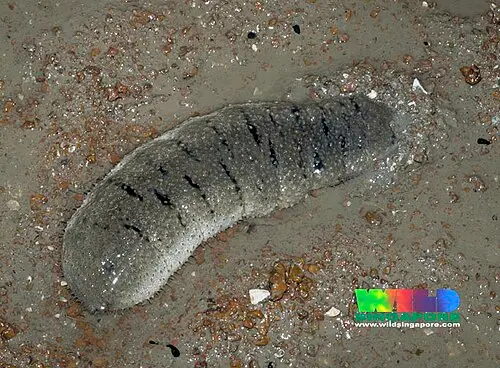
 📸 Photo
Photo: Ria Tan from singapore · CC BY-SA 2.0 · Wikimedia Commons Source
Sandfish
Holothuria scabra (Sandfish · Sandfish)
💡 Everyday Comparisons for Size, Mass & Speed
- 💡 Its common length of 22 cm is about 3/4 of the long side of an A4 sheet of paper (29.7 cm) (Comparison).
- 💡 Its maximum weight of 1.5 kg is similar to the weight of a single 1.5 L bottle of water (Comparison).
- 💡 Boiled and dried sea cucumber products fetch high prices and are in high demand. During processing, they are buried overnight and brushed the next day to remove their spicules (SeaLifeBase).
Reference standards: coach bus ~12 m, mid-size car ~4.9 m, compact car ~1 t, basketball hoop 3.05 m, credit card 8.56 cm.
Site-computed relative index from recorded values; not a formal scientific metric.
📖 1. Overview
The sandfish is a sea cucumber living on muddy and sandy bottoms in shallow Indo-Pacific waters. It accounts for a major share of dried sea cucumber products and was assessed as Vulnerable (VU, 2026) on the IUCN Red List.
🦴 2. Anatomy & Morphology
Its body is oval with a rounded back and a flat belly, and 20 short, stout gray tentacles surround the mouth. Body color ranges from white to dark brown, and the body wall is 0.6 cm thick.
🔍 3. Ecology & Behavior
It stays buried in sand during the day, lives in groups, and feeds on organic detritus in muddy bottoms. In some places it gathers at densities of one individual per 1 m², and hand-collecting at low tide is widely practiced.
🇰🇷 4. Connection to Korea
No direct record connecting this species to Korea has been found.
📚 Sources & References
- • IUCN Red List VU (2026) — https://www.iucnredlist.org/species/180257/272668462
- • IUCN Red List category VU — latest assessment at iucnredlist.org
- • marinespecies.org — aphia.php
- • iucnredlist.org — 272668462
- • wikidata.org — Q2395506
- • commons.wikimedia.org — File:Garlic bread sea cucumber (Holothuria scabra).jpg
- • sealifebase.se — Holothuria-scabra.html
- • Silhouette: PhyloPic — author not recorded · CC0 1.0 (Congeneric silhouette — Physalia physalis)
Recorded dimensions are widely cited representative estimates from public literature and may vary by study or specimen.