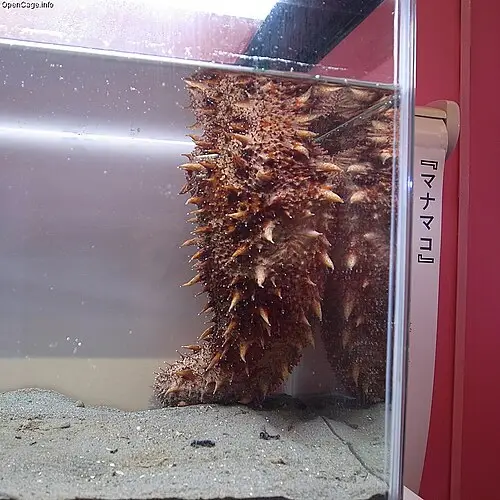
 📸 Photo
Photo: OpenCage · CC BY-SA 2.5 · Wikimedia Commons Source
Japanese sea cucumber
Apostichopus japonicus (Japanese sea cucumber · マナマコ)
💡 Everyday Comparisons for Size, Mass & Speed
- 💡 It is used as food and occurs throughout all waters of Korea (Encyclopedia of Korean Culture).
- 💡 After wild populations were overfished in the 1990s, aquaculture spread widely along the northern coast of China, and Chinese farmed production peaked in 2005 at over 60,000 plus 5,000 tons (SeaLifeBase).
- 💡 Its maximum body length of 30 cm is almost equal to the long side of an A4 sheet of paper (29.7 cm) (Comparison).
Reference standards: coach bus ~12 m, mid-size car ~4.9 m, compact car ~1 t, basketball hoop 3.05 m, credit card 8.56 cm.
📖 1. Overview
The Japanese sea cucumber is an edible sea cucumber with a cucumber-shaped body found across all Korean waters. The IUCN Red List assesses it as Endangered (EN, 2026).
🦴 2. Anatomy & Morphology
Its body has about 6 rows of large conical projections (papillae) and 3 rows of tube feet on the underside. Individuals living on outer-sea rocks are brown, while those on inner-sea rocks are dark bluish-green or black.
🔍 3. Ecology & Behavior
It swallows bottom sediment to feed on organic matter such as bacteria, protozoa, diatoms, and plant and animal detritus. The red form is common on outer-sea gravel bottoms, while the green and black forms are common on inner-sea sandy and muddy bottoms.
🇰🇷 4. Connection to Korea
It occurs in all Korean waters, is widely used as food, and reaches about 30 cm in body length. It is listed as 'Dolgihaesam' (Korean name) in the National List of Species of Korea.
📚 Sources & References
- • IUCN Red List EN (2026) — https://www.iucnredlist.org/species/180424/272708369
- • IUCN Red List category EN — latest assessment at iucnredlist.org
- • marinespecies.org — aphia.php
- • iucnredlist.org — 272708369
- • 국가생물종목록(국립생물자원관) ktsn 120000050866 — https://species.nibr.go.kr/home/mainHome.do?cont_link=009&subMenu=009002&contCd=009002&ktsn=120000050866
- • wikidata.org — Q2198517
- • commons.wikimedia.org — File:Apostichopus japonicus.jpg
- • sealifebase.se — Apostichopus-japonicus.html
- • encykorea.aks.ac.kr — E0062606
- • Silhouette: PhyloPic — François Michonneau · CC0 1.0 (Related taxon silhouette — Thelenota rubralineta)
Recorded dimensions are widely cited representative estimates from public literature and may vary by study or specimen.