 📸 Photo
Photo: Public domain · Public domain · Wikimedia Commons Source
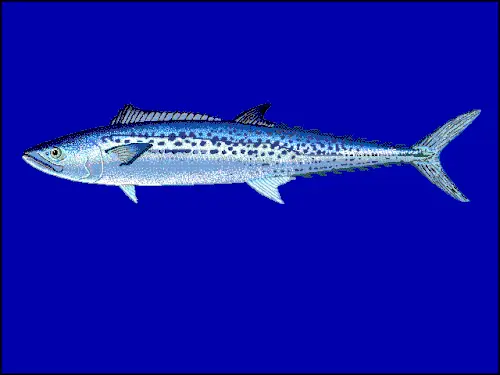
Japanese Spanish mackerel
Scomberomorus niphonius (Japanese Spanish mackerel · サワラ)
💡 Everyday Comparisons for Size, Mass & Speed
- 💡 Its body length of about 1 m is the length of a single 1 m ruler (Comparison).
- 💡 It is known to be especially tasty in winter and is eaten pan-fried, broiled, or baked (FishBase).
- 💡 In Korea, it can be seen in southwestern coastal waters including Jeju Island (National List of Species of Korea).
Reference standards: coach bus ~12 m, mid-size car ~4.9 m, compact car ~1 t, basketball hoop 3.05 m, credit card 8.56 cm.
Site-computed relative index from recorded values; not a formal scientific metric.
📖 1. Overview
The Japanese Spanish mackerel is a slender, elongated fish of the mackerel family living in surface waters over continental shelves and coasts. It is an important species that is cultured and released for fisheries in Japan.
🦴 2. Anatomy & Morphology
Its body is long, slender, and low-bodied spindle-shaped, with a blue back and a silvery-white belly scattered with grayish-blue spots. The rear margin of the caudal fin is deeply forked, and it has no swim bladder.
🔍 3. Ecology & Behavior
It feeds on small fish, gathers in inner bays around April to May to spawn, and moves to shallow waters in summer and deeper waters in winter. In Japan's inland sea, it makes a spawning migration in spring and a feeding migration in autumn.
🇰🇷 4. Connection to Korea
According to the National List of Species of Korea, it lives in southwestern coastal waters of Korea, including Jeju Island.
📚 Sources & References
- • IUCN Red List NT (2023) — https://www.iucnredlist.org/species/170356/170090130
- • IUCN Red List category NT — latest assessment at iucnredlist.org
- • catalogueoflife.org — 4VTXK
- • iucnredlist.org — 170090130
- • 국가생물종목록(국립생물자원관) ktsn 120000059171 — https://species.nibr.go.kr/home/mainHome.do?cont_link=009&subMenu=009002&contCd=009002&ktsn=120000059171
- • wikidata.org — Q247720
- • commons.wikimedia.org — File:Scnip u0.gif
- • fishbase.se — Scomberomorus-niphonius.html
- • species.nibr.go.kr — mainHome.do
- • Silhouette: PhyloPic — John E. Randall (vectorized by Russell Engelman) · CC BY 4.0 (Congeneric silhouette — Scomberomorus guttatus)
Recorded dimensions are widely cited representative estimates from public literature and may vary by study or specimen.