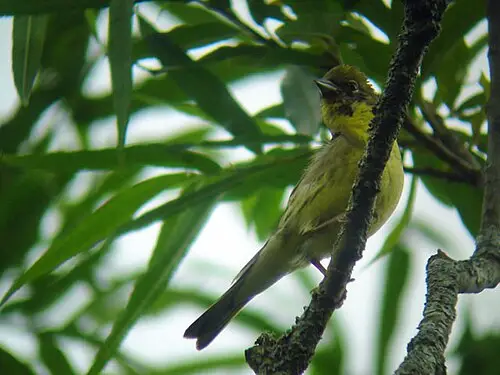
 📸 Photo
Photo: Koolah ( talk ) · CC BY-SA 3.0 · Wikimedia Commons Source
Yellow Bunting
Schoeniclus sulphuratus (Yellow Bunting · ノジコ)
💡 Everyday Comparisons for Size, Mass & Speed
- 💡 A male's weight of 15.2 g is almost the same as two Korean 500-won coins (about 15.4 g) (Comparison).
- 💡 According to the National Institute of Ecology, it is a rare bird passing through Geojedo and Jeju Island in spring and autumn, and trapping for the pet trade is a threat.
Reference standards: coach bus ~12 m, mid-size car ~4.9 m, compact car ~1 t, basketball hoop 3.05 m, credit card 8.56 cm.
Site-computed relative index from recorded values; not a formal scientific metric.
📖 1. Overview
The Yellow Bunting is a small bird that breeds only in Japan and winters in China, Taiwan, and the Philippines. In Korea, it is a very rare passage migrant that briefly passes through in spring and autumn.
🦴 2. Anatomy & Morphology
Its body length is 13–14 cm, and average weight is 15.2 g in males and 14.6 g in females. It has a distinct white eye-ring, a yellow chin, grayish-green upperparts, and a pale yellow breast and belly.
🔍 3. Ecology & Behavior
It favors insects, spiders, and seeds of the mint family. From mid-May to early July, it builds a bowl-shaped nest on shrub branches and lays 3–5 eggs.
🇰🇷 4. Connection to Korea
The National Institute of Ecology notes that it is a very rare passage migrant passing through Geojedo and Jeju Island in small flocks in spring and autumn, and that its IUCN status changed from Vulnerable (VU) to Least Concern (LC) in 2022.
📚 Sources & References
- • IUCN Red List LC (2022) — https://www.iucnredlist.org/species/22720996/154686501
- • IUCN Red List category LC — latest assessment at iucnredlist.org
- • doi.org — avilist.v2026
- • iucnredlist.org — 154686501
- • wikidata.org — Q1588177
- • commons.wikimedia.org — File:Emberiza sulphurata.jpg
- • nie.re.kr — view.do
- • Silhouette: PhyloPic — Ferran Sayol · CC0 1.0 (Related taxon silhouette — Emberiza alcoveri)
Recorded dimensions are widely cited representative estimates from public literature and may vary by study or specimen.