 📸 Photo
Photo: Robert tdc · CC BY-SA 2.0 · Wikimedia Commons Source
Yellow-throated Bunting
Schoeniclus elegans (Yellow-throated Bunting · ミヤマホオジロ)
💡 Everyday Comparisons for Size, Mass & Speed
- 💡 Because it is less wary of people than other buntings, it can be watched foraging at close range (Hong Kong Bird Watching Society).
- 💡 Records cluster during spring and autumn migration, making stopover islands popular spots for birdwatching (Hong Kong Bird Watching Society).
Reference standards: coach bus ~12 m, mid-size car ~4.9 m, compact car ~1 t, basketball hoop 3.05 m, credit card 8.56 cm.
📖 1. Overview
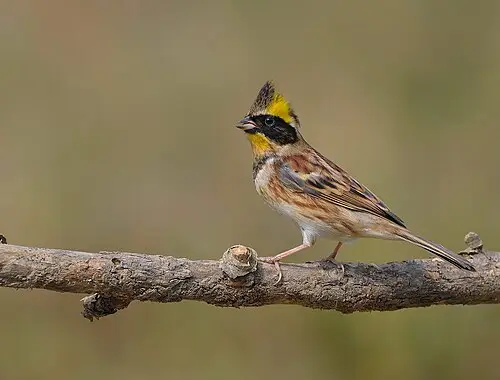
The Yellow-throated Bunting is a bunting that breeds on the Korean Peninsula, in northeastern China, and in the Russian Far East, notable for the male's yellow throat and black face.
🦴 2. Anatomy & Morphology
It frequently raises its crest feathers, and males have a black forehead, a broad black band from in front of the eyes to the neck, a black crescent on the breast, and a yellow hindcrown and throat.
🔍 3. Ecology & Behavior
In Hong Kong records, it was often seen feeding on seeds close to people. Its breeding range is Northeast Asia including the Korean Peninsula, and in winter it moves from the Korean Peninsula down to eastern and southeastern coastal China.
🇰🇷 4. Connection to Korea
It breeds on the Korean Peninsula and moves from the Korean Peninsula toward eastern China for the winter (Hong Kong Bird Watching Society range description).
📚 Sources & References
- • IUCN Red List LC (2018) — https://www.iucnredlist.org/species/22720963/132005507
- • IUCN Red List category LC — latest assessment at iucnredlist.org
- • doi.org — avilist.v2026
- • iucnredlist.org — 132005507
- • 국가생물종목록(국립생물자원관) ktsn 120000002224 — https://species.nibr.go.kr/home/mainHome.do?cont_link=009&subMenu=009002&contCd=009002&ktsn=120000002224
- • wikidata.org — Q1193779
- • commons.wikimedia.org — File:Emberiza elegans.jpg
- • avifauna.hkbws.org.hk — 056600
- • Silhouette: PhyloPic — Ferran Sayol · CC0 1.0 (Related taxon silhouette — Emberiza alcoveri)
Recorded dimensions are widely cited representative estimates from public literature and may vary by study or specimen.