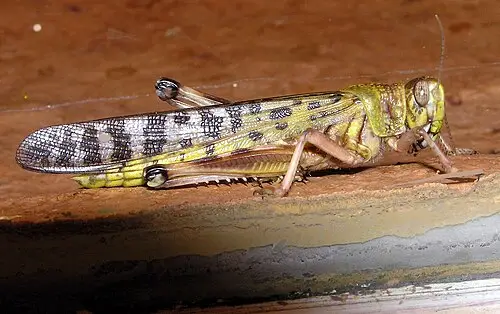
 📸 Photo
Photo: Arpingstone · Public domain · Wikimedia Commons Source
Desert locust
Schistocerca gregaria (Desert locust · サバクトビバッタ)
Not Evaluated (NE) on the IUCN Red List yet.
💡 Everyday Comparisons for Size, Mass & Speed
- 💡 According to the FAO, a 1 km² swarm holds up to 80 million adults and eats the same amount of food in a day as 30,000 plus 5,000 people.
- 💡 When desert locust swarms surged across East Africa, Southwest Asia, and around the Red Sea in early 2020, the FAO made addressing them one of its highest priorities.
Reference standards: coach bus ~12 m, mid-size car ~4.9 m, compact car ~1 t, basketball hoop 3.05 m, credit card 8.56 cm.
📖 1. Overview
The desert locust is regarded as the most destructive migratory pest in the world. Normally living scattered across arid regions of Africa, the Near East, and Southwest Asia, it forms dense, highly mobile swarms when triggered by environmental conditions.
🦴 2. Anatomy & Morphology
Nymphs (hoppers) hatched from eggs grow wings and become adults after about 6 weeks, and adults take at least another month to mature enough to lay eggs. A single locust eats its own body weight in food each day. Body size is not listed in the FAO source.
🔍 3. Ecology & Behavior
Its lifespan is about 3 months, and eggs laid in moist sandy soil hatch after about two weeks. Flying with the wind by day up to 150 km a day, its numbers multiply rapidly each generation—increasing 20-fold after 3 months, 400-fold after 6 months, and 8,000-fold after 9 months.
🇰🇷 4. Connection to Korea
No direct record connecting this species to Korea has been found.
📚 Sources & References
- • IUCN Red List: not evaluated (NE) — cross-checked with the Wikidata conservation-status entry
- • catalogueoflife.org — 4V94G
- • wikidata.org — Q281634
- • commons.wikimedia.org — File:Desert.locust.arp.jpg
- • fao.org — en
- • Silhouette: PhyloPic — Graham Montgomery · CC BY 4.0 (Related taxon silhouette — Acrididae)
Recorded dimensions are widely cited representative estimates from public literature and may vary by study or specimen.