 📸 Photo
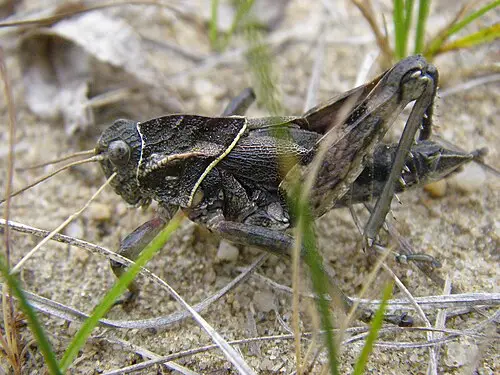
Photo: Sergey Storozhenko · CC BY 4.0 · Wikimedia Commons Source
Haplotropis brunneriana
Haplotropis brunneriana (Haplotropis brunneriana · Haplotropis brunneriana)
Not Evaluated (NE) on the IUCN Red List yet.
🇰🇷 Class II endangered wildlife (Korea)
💡 Everyday Comparisons for Size, Mass & Speed
- 💡 The female's maximum body length of 50 mm is about 1.9 times the diameter of a Korean 500-won coin (26.5 mm) (Comparison).
- 💡 Building forest roads on mountains and losing grasslands fragments the habitat of this flightless, slow-moving grasshopper; the National Institute of Ecology cites this as a cause of its population decline.
Reference standards: coach bus ~12 m, mid-size car ~4.9 m, compact car ~1 t, basketball hoop 3.05 m, credit card 8.56 cm.
📖 1. Overview
Haplotropis brunneriana is a ground-dwelling grasshopper in the family Pamphagidae whose wings are reduced so it cannot fly. In Korea, it is a Class II endangered wildlife (Korea).
🦴 2. Anatomy & Morphology
Males are 28–37 mm long and females 35–50 mm, making it large and stout. Its wings are reduced to tiny scale-like stubs, and its grayish-brown or dark brown body blends in among fallen leaves.
🔍 3. Ecology & Behavior
Adults appear in May and June and move slowly because they cannot fly. It overwinters as an egg, a single female lays a small clutch averaging 17 eggs, and both nymphs and adults chew on grasses, sedges, and leaves of small shrubs.
🇰🇷 4. Connection to Korea
In the past it lived nationwide, but recently it is confirmed only in a few areas such as Yeongwol-gun in Gangwon-do, and it is a Class II endangered wildlife (Korea). Forest road construction and shrinking grasslands have fragmented its habitat and reduced its numbers.
📚 Sources & References
- • 멸종위기 야생생물 Ⅱ급 — 국가생물종목록(국립생물자원관) ktsn 120000037672 — https://species.nibr.go.kr/home/mainHome.do?cont_link=009&subMenu=009002&contCd=009002&ktsn=120000037672
- • IUCN Red List: not evaluated (NE) — cross-checked with the Wikidata conservation-status entry
- • Korean protection status: Class II endangered wildlife (Korea)
- • catalogueoflife.org — 6LCKG
- • 국가생물종목록(국립생물자원관) ktsn 120000037672 — https://species.nibr.go.kr/home/mainHome.do?cont_link=009&subMenu=009002&contCd=009002&ktsn=120000037672
- • wikidata.org — Q10517894
- • commons.wikimedia.org — File:Haplotropis brunneriana.jpg
- • nie.re.kr — view.do
Recorded dimensions are widely cited representative estimates from public literature and may vary by study or specimen.