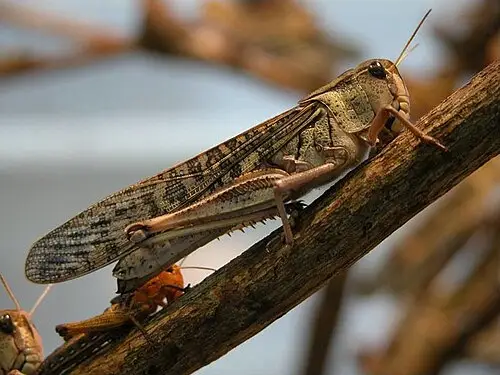
 📸 Photo
Photo: Jonathan Hornung · CC BY-SA 2.0 de · Wikimedia Commons Source
Migratory locust
Locusta migratoria (Migratory locust · トノサマバッタ)
Not Evaluated (NE) on the IUCN Red List yet.
💡 Everyday Comparisons for Size, Mass & Speed
- 💡 A body length of 6.5 cm is about 3/4 the long side of a credit card (8.56 cm) (Comparison).
- 💡 It can be seen in riverside and foothill grasslands from June to November, and sometimes occurs in mass outbreaks on islands (National List of Species of Korea).
Reference standards: coach bus ~12 m, mid-size car ~4.9 m, compact car ~1 t, basketball hoop 3.05 m, credit card 8.56 cm.
📖 1. Overview
The migratory locust is a large grasshopper living in lowland grasslands, foothill meadows, and riverbanks throughout the Korean Peninsula, and is distributed across the Palearctic realm including Japan, China, and Europe.
🦴 2. Anatomy & Morphology
It is a large grasshopper with a body length of 48–65 mm and comes in green and brown forms. The hindwings are transparent yellow without black markings, and the area around the mandibles is blue.
🔍 3. Ecology & Behavior
Adults appear from June to November and produce 2 or more generations a year depending on environmental conditions. On islands or in isolated areas, very large individuals appear and mass outbreaks sometimes occur.
🇰🇷 4. Connection to Korea
It is distributed throughout the Korean Peninsula (National List of Species of Korea).
📚 Sources & References
- • IUCN Red List: not evaluated (NE) — cross-checked with the Wikidata conservation-status entry
- • catalogueoflife.org — 72LGF
- • 국가생물종목록(국립생물자원관) ktsn 120000037504 — https://species.nibr.go.kr/home/mainHome.do?cont_link=009&subMenu=009002&contCd=009002&ktsn=120000037504
- • wikidata.org — Q1059580
- • commons.wikimedia.org — File:Wanderheuschrecke-03.jpg
- • species.nibr.go.kr — mainHome.do
- • Silhouette: PhyloPic — Graham Montgomery · CC BY 4.0 (Related taxon silhouette — Acrididae)
Recorded dimensions are widely cited representative estimates from public literature and may vary by study or specimen.