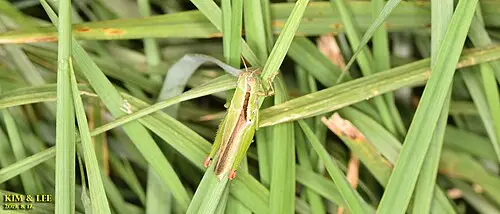
 📸 Photo
Photo: Kim, Hyun-tae Depicted place: Seosan, Chungcheongnam-do, South Korea ( 36°44′56″N 126°26′24″E / 36.7488116667°N 126.4399416667°E / 36.7488116667; 126.4399416667 · CC BY 4.0 · Wikimedia Commons Source
Rice grasshopper
Oxya sinuosa (Rice grasshopper · Rice grasshopper)
Not Evaluated (NE) on the IUCN Red List yet.
💡 Everyday Comparisons for Size, Mass & Speed
- 💡 A body length of 35 mm is slightly longer than the diameter of a Korean 500-won coin (26.5 mm) (Comparison).
- 💡 In Korea, 7 insect species—including the two-spotted cricket, yellow mealworm (Gal-saek-geo-jeo-ri, a Korean beetle name) larvae, and Japanese rhinoceros beetle larvae—are approved as food ingredients, and the rice grasshopper is one of them.
Reference standards: coach bus ~12 m, mid-size car ~4.9 m, compact car ~1 t, basketball hoop 3.05 m, credit card 8.56 cm.
📖 1. Overview
The rice grasshopper is an orthopteran grasshopper frequently referred to as Oxya chinensis sinuosa in scientific papers. It is a representative edible insect eaten in Korea since olden times.
🦴 2. Anatomy & Morphology
Its body length is 21–35 mm, and it is a hemimetabolous insect that does not go through a pupal stage.
🔍 3. Ecology & Behavior
It appears between August and October and feeds on plants. When dried, protein accounts for about 74% of its weight.
🇰🇷 4. Connection to Korea
It is one of the 7 edible insect species approved as food ingredients in Korea, where it has long been eaten as food and used as medicine. It is listed as 'U-ri-byeo-me-ttu-gi' (Korean name) on the National List of Species of Korea.
📚 Sources & References
- • IUCN Red List: not evaluated (NE) — cross-checked with the Wikidata conservation-status entry
- • catalogueoflife.org — 4BC9H
- • 국가생물종목록(국립생물자원관) ktsn 120000129923 — https://species.nibr.go.kr/home/mainHome.do?cont_link=009&subMenu=009002&contCd=009002&ktsn=120000129923
- • wikidata.org — Q108626978
- • commons.wikimedia.org — File:Oxya sinuosa - inat 48448261.jpg
- • pmc.ncbi.nlm.nih.gov — PMC11097018
- • pmc.ncbi.nlm.nih.gov — PMC11509906
- • pmc.ncbi.nlm.nih.gov — PMC10271924
- • Silhouette: PhyloPic — Graham Montgomery · CC BY 4.0 (Related taxon silhouette — Acrididae)
Recorded dimensions are widely cited representative estimates from public literature and may vary by study or specimen.