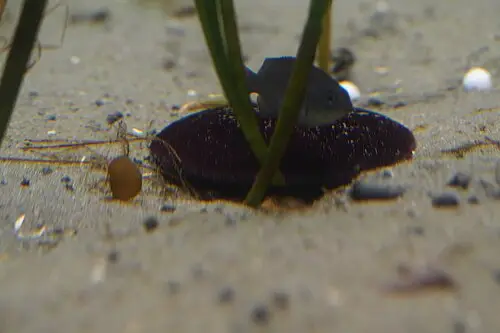
 📸 Photo
Photo: harum.koh from Kobe city, Japan · CC BY-SA 2.0 · Wikimedia Commons Source
Scaphechinus mirabilis
Scaphechinus mirabilis (Scaphechinus mirabilis · ハスノハカシパン)
Not Evaluated (NE) on the IUCN Red List yet.
💡 Everyday Comparisons for Size, Mass & Speed
- 💡 Its test size of 77 mm is slightly smaller than the long side of a credit card (about 86 mm), making it about the size of a single card (Comparison).
- 💡 It is a sea urchin recorded along Korean coasts including Jumunjin and Samcheok in Gangwon-do, Yeongilman in Pohang, and Busan (National List of Species of Korea domestic distribution).
Reference standards: coach bus ~12 m, mid-size car ~4.9 m, compact car ~1 t, basketball hoop 3.05 m, credit card 8.56 cm.
📖 1. Overview
Scaphechinus mirabilis is a flat, disc-shaped sea urchin (sand dollar) living in Korea, Japan, northern China, Kamchatka, and the Aleutian Islands.
🦴 2. Anatomy & Morphology
Its test is 54–77 mm long, with a rounded pentagonal or disc shape and similar length and width. The oral side is flat while the center of the aboral side rises slightly, and the petaloid pattern takes up nearly half the test length. When alive it is pale purple, and the test stripped of spines is white.
🔍 3. Ecology & Behavior
It lives on the bottom from the lower intertidal zone down to 125 m deep. Large tubercles densely cover the entire surface of the test and are especially abundant on the aboral side.
🇰🇷 4. Connection to Korea
It is listed on the National List of Species of Korea and has been recorded in Jumunjin, Samcheok, Yeongilman, Busan, Namhaedo, and Nokdong.
📚 Sources & References
- • IUCN Red List: not evaluated (NE) — cross-checked with the Wikidata conservation-status entry
- • marinespecies.org — aphia.php
- • 국가생물종목록(국립생물자원관) ktsn 120000050788 — https://species.nibr.go.kr/home/mainHome.do?cont_link=009&subMenu=009002&contCd=009002&ktsn=120000050788
- • wikidata.org — Q2134025
- • commons.wikimedia.org — File:Scaphechinus mirabilis (16062551152).jpg
- • species.nibr.go.kr — mainHome.do
- • Silhouette: PhyloPic — Caleb M. Gordon · CC BY 4.0 (Related taxon silhouette — Scutella)
Recorded dimensions are widely cited representative estimates from public literature and may vary by study or specimen.