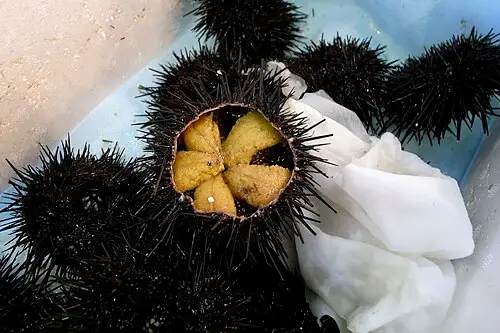
 📸 Photo
Photo: Naotake Murayama from San Francisco, CA, USA · CC BY 2.0 · Wikimedia Commons Source
Heliocidaris crassispina
Heliocidaris crassispina (Heliocidaris crassispina · ムラサキウニ)
Not Evaluated (NE) on the IUCN Red List yet.
💡 Everyday Comparisons for Size, Mass & Speed
- 💡 Its maximum test diameter of 7.7 cm is slightly smaller than the long side of a credit card (about 8.6 cm).
- 💡 It is the most common edible sea urchin found along all coasts of Korea (National List of Species of Korea).
Reference standards: coach bus ~12 m, mid-size car ~4.9 m, compact car ~1 t, basketball hoop 3.05 m, credit card 8.56 cm.
📖 1. Overview
Heliocidaris crassispina is the most common edible sea urchin living along all coasts of Korea. Its commercial value is especially high in Jeju Island.
🦴 2. Anatomy & Morphology
The test is large, hard, and hemispherical, and both the test and spines are deep purple. The primary spines are nearly equal in length to the diameter of the test, and it moves using tube feet.
🔍 3. Ecology & Behavior
It clusters in rock crevices or under large boulders, which is thought to reduce the impact of waves. It is an opportunistic feeder that eats mainly seaweeds, and its maximum reported lifespan is 11 years.
🇰🇷 4. Connection to Korea
It is listed in the National List of Species of Korea and inhabits all Korean coasts. As the most common edible sea urchin, it holds particularly high commercial value in Jeju Island.
📚 Sources & References
- • IUCN Red List: not evaluated (NE) — cross-checked with the Wikidata conservation-status entry
- • marinespecies.org — aphia.php
- • 국가생물종목록(국립생물자원관) ktsn 120000050769 — https://species.nibr.go.kr/home/mainHome.do?cont_link=009&subMenu=009002&contCd=009002&ktsn=120000050769
- • wikidata.org — Q1894680
- • commons.wikimedia.org — File:Fresh Sea Urchin (2678940158).jpg
- • sealifebase.se — Heliocidaris-crassispina.html
- • species.nibr.go.kr — mainHome.do
- • Silhouette: PhyloPic — author not recorded · CC0 1.0 (Related taxon silhouette — Colobocentrotus atratus)
Recorded dimensions are widely cited representative estimates from public literature and may vary by study or specimen.