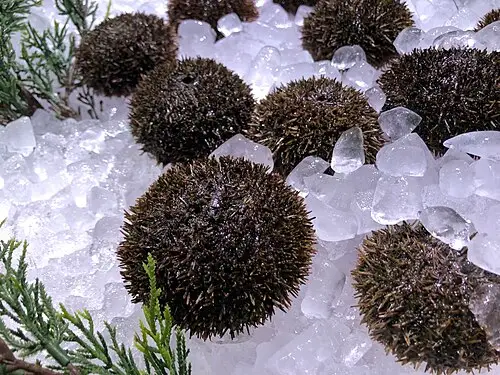
 📸 Photo
Photo: Totti · CC BY-SA 4.0 · Wikimedia Commons Source
Hemicentrotus pulcherrimus
Hemicentrotus pulcherrimus (Hemicentrotus pulcherrimus · バフンウニ)
Not Evaluated (NE) on the IUCN Red List yet.
💡 Everyday Comparisons for Size, Mass & Speed
- 💡 In Jeju Island, it is called 'Som' and is a sea urchin of high commercial value (National List of Species of Korea).
- 💡 Because it is the most common sea urchin in Korea, it can be met anywhere along the shore, though it is not yet farmed (National List of Species of Korea).
Reference standards: coach bus ~12 m, mid-size car ~4.9 m, compact car ~1 t, basketball hoop 3.05 m, credit card 8.56 cm.
📖 1. Overview
Hemicentrotus pulcherrimus is the most common sea urchin along all coasts of Korea and also lives in Japan and northeastern China.
🦴 2. Anatomy & Morphology
The test is small to medium-sized, a low and flattened hemisphere that is relatively hard. The primary spines are thin and short.
🔍 3. Ecology & Behavior
It lives from the intertidal zone to depths of over 30 m. It has not yet been farmed, and is said to have high resource value if aquaculture succeeds.
🇰🇷 4. Connection to Korea
It is listed in the National List of Species of Korea and inhabits all Korean coasts. In Jeju Island, it is called 'Som' and has high commercial value, and overseas export of Korean populations must be strictly controlled before it is registered as a native product.
📚 Sources & References
- • IUCN Red List: not evaluated (NE) — cross-checked with the Wikidata conservation-status entry
- • marinespecies.org — aphia.php
- • 국가생물종목록(국립생물자원관) ktsn 120000050772 — https://species.nibr.go.kr/home/mainHome.do?cont_link=009&subMenu=009002&contCd=009002&ktsn=120000050772
- • wikidata.org — Q2409706
- • commons.wikimedia.org — File:Hemicentrotus pulcherrimus in market.jpg
- • species.nibr.go.kr — mainHome.do
- • Silhouette: PhyloPic — Harold N Eyster · CC BY 3.0 (Related taxon silhouette — Strongylocentrotus purpuratus)
Recorded dimensions are widely cited representative estimates from public literature and may vary by study or specimen.