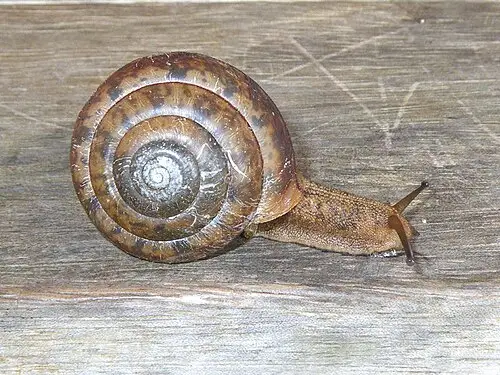
 📸 Photo
Photo: ふうけ · Public domain · Wikimedia Commons Source
Satsuma myomphala
Satsuma myomphala (Satsuma myomphala · コベソマイマイ)
Not Evaluated (NE) on the IUCN Red List yet.
🇰🇷 Class II endangered wildlife (Korea)
💡 Everyday Comparisons for Size, Mass & Speed
- 💡 Because being stepped on or caught by tourists is a threat factor (National Institute of Ecology), watching the ground when walking along coastal forest trails in Geoje is a direct way to protect it.
- 💡 Its foods—mushrooms, moss, and fruits—are things we commonly see along forest trails, making the edges of forest paths the dining table of this snail (National Institute of Ecology).
Reference standards: coach bus ~12 m, mid-size car ~4.9 m, compact car ~1 t, basketball hoop 3.05 m, credit card 8.56 cm.
📖 1. Overview
Satsuma myomphala is a large land snail living in Northeast Asia, and in Korea it is distributed only in Geoje-si, Gyeongsangnam-do.
🦴 2. Anatomy & Morphology
Its shell is yellowish-brown with 6–7 whorls and a large, rounded body whorl. A reddish-brown band starts in the middle of the body whorl and continues above the suture.
🔍 3. Ecology & Behavior
Living in forests near the coast, it eats mushrooms, moss, fruits, and wood. As a hermaphrodite, it is known to lay eggs underground or under fallen leaves, though its exact life history has not been studied.
🇰🇷 4. Connection to Korea
It is a Class II endangered wildlife (Korea) species distributed only in Geoje-si in Korea. Being stepped on or collected by tourists and habitat development are the main threat factors.
📚 Sources & References
- • 멸종위기 야생생물 Ⅱ급 — 국가생물종목록(국립생물자원관) ktsn 120000043356 — https://species.nibr.go.kr/home/mainHome.do?cont_link=009&subMenu=009002&contCd=009002&ktsn=120000043356
- • IUCN Red List: not evaluated (NE) — cross-checked with the Wikidata conservation-status entry
- • Korean protection status: Class II endangered wildlife (Korea)
- • catalogueoflife.org — 6XQBD
- • 국가생물종목록(국립생물자원관) ktsn 120000043356 — https://species.nibr.go.kr/home/mainHome.do?cont_link=009&subMenu=009002&contCd=009002&ktsn=120000043356
- • wikidata.org — Q7426502
- • commons.wikimedia.org — File:Kobesomaimai1007.jpg
- • nie.re.kr — view.do
Recorded dimensions are widely cited representative estimates from public literature and may vary by study or specimen.