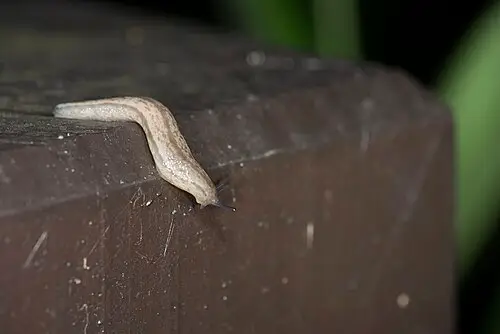
 📸 Photo
Photo: LiCheng Shih · CC BY 2.0 · Wikimedia Commons Source
Chinese slug
Meghimatium bilineatum (Chinese slug · Chinese slug)
Not Evaluated (NE) on the IUCN Red List yet.
💡 Everyday Comparisons for Size, Mass & Speed
- 💡 It comes out to look for food after rain and is also found in farmland and urban landscaped areas (California Department of Food and Agriculture data).
- 💡 In China, extracts of this slug have been used as a medicinal ingredient to treat infectious diseases (2024 genome paper).
- 💡 Researchers at the Rural Development Administration confirmed this slug in greenhouse perilla farms (2010).
Reference standards: coach bus ~12 m, mid-size car ~4.9 m, compact car ~1 t, basketball hoop 3.05 m, credit card 8.56 cm.
📖 1. Overview
The Chinese slug (Meghimatium bilineatum) is a shell-less land slug known in East Asia as a pest that damages farm crops, horticultural crops, grasslands, and forests. In China, it is also used in traditional medicine.
🦴 2. Anatomy & Morphology
Like other slugs, it lacks a shell, protects its body with mucus, and breathes air with a lung. Because it has no shell, it moves relatively quickly to escape predators.
🔍 3. Ecology & Behavior
It stays in damp places and comes out to forage after rain, eating both living and rotting plants indiscriminately. In the laboratory, females live up to 4 years and lay an average of 932 eggs.
🇰🇷 4. Connection to Korea
It is listed on the National List of Species of Korea as Min-dalpaengi (Korean name). In a survey of greenhouse perilla farms in Miryang, Gyeongsangnam-do and Busan, it was identified as one of 4 snail and slug species, though its numbers were so low that there was no distinct peak season.
📚 Sources & References
- • IUCN Red List: not evaluated (NE) — cross-checked with the Wikidata conservation-status entry
- • catalogueoflife.org — 3YZZK
- • 국가생물종목록(국립생물자원관) ktsn 120000133185 — https://species.nibr.go.kr/home/mainHome.do?cont_link=009&subMenu=009002&contCd=009002&ktsn=120000133185
- • wikidata.org — Q10912453
- • commons.wikimedia.org — File:Meghimatium bilineatum (42842300394).jpg
- • blogs.cdfa.ca.gov — Section3162
- • pmc.ncbi.nlm.nih.gov — PMC10770140
- • koreascience.or.kr — JAKO201014435570693.pub
Recorded dimensions are widely cited representative estimates from public literature and may vary by study or specimen.