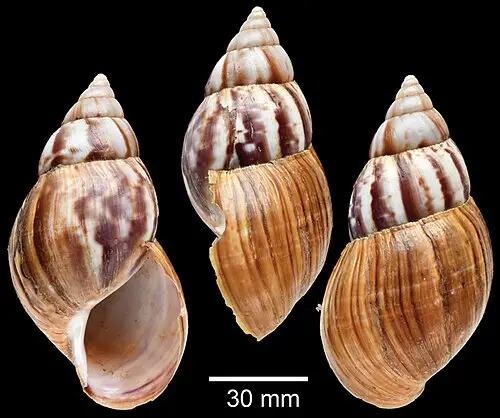
 📸 Photo
Photo: Sutcharit C, Thach P, Chhuoy S, Ngor PB, Jeratthitikul E, Siriwut W, Srisonchai R, Ng TH, Pholyotha A, Jirapatrasilp P, Panha S (2020) Annotated checklist of th · CC BY 4.0 · Wikimedia Commons Source
Giant African land snail
Lissachatina fulica (Giant African land snail · Giant African land snail)
Not Evaluated (NE) on the IUCN Red List yet.
💡 Everyday Comparisons for Size, Mass & Speed
- 💡 Its maximum length of 30 cm is the same length as a 30 cm ruler (Comparison).
- 💡 Its average weight of 32 g is about half that of a chicken egg (about 60 g) (Comparison).
- 💡 It is eaten around the world as a source of protein, but because it is a host of the rat lungworm, it must be thoroughly cooked (ADW).
Reference standards: coach bus ~12 m, mid-size car ~4.9 m, compact car ~1 t, basketball hoop 3.05 m, credit card 8.56 cm.
Site-computed relative index from recorded values; not a formal scientific metric.
📖 1. Overview
The giant African land snail is a very large land snail native to the East African coast that has spread to many countries around the world through human activity.
🦴 2. Anatomy & Morphology
When fully grown, it is a large snail reaching up to about 30 cm in length. Its conical shell is about twice as high as it is wide and usually has 7–9 whorls.
🔍 3. Ecology & Behavior
It is mainly herbivorous, eating both living and dead plant matter and favoring vegetable garden crops. It rests in the soil during the day and is active at night, and as a hermaphrodite it lays 100–500 eggs per mating.
🇰🇷 4. Connection to Korea
It is listed on the National List of Species of Korea under the name Wang-dalpaengi (Korean name).
📚 Sources & References
- • IUCN Red List: not evaluated (NE) — cross-checked with the Wikidata conservation-status entry
- • catalogueoflife.org — 7RXXP
- • 국가생물종목록(국립생물자원관) ktsn 120000133083 — https://species.nibr.go.kr/home/mainHome.do?cont_link=009&subMenu=009002&contCd=009002&ktsn=120000133083
- • wikidata.org — Q103781974
- • commons.wikimedia.org — File:Lissachatina fulica (10.3897-zookeys.948.51671) Figure
- • animaldiversity.org — Achatina fulica
- • species.nibr.go.kr — mainHome.do
- • Silhouette: PhyloPic — Ferran Sayol · CC0 1.0
Recorded dimensions are widely cited representative estimates from public literature and may vary by study or specimen.