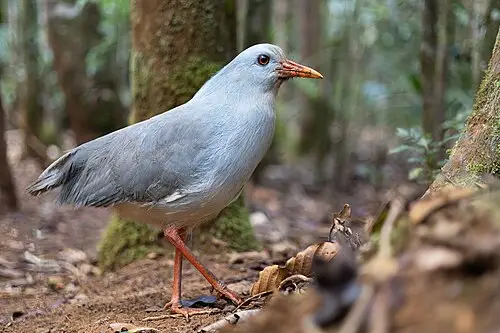
 📸 Photo
Photo: JJ Harrison · CC BY-SA 3.0 · Wikimedia Commons Source
Kagu
Rhynochetos jubatus (Kagu · カグー)
💡 Everyday Comparisons for Size, Mass & Speed
- 💡 In the 19th century, its crest feathers became popular for decorating women's hats, nearly driving the species to extinction (San Diego Zoo).
- 💡 Its body length of about 55 cm is around the size of a chicken (San Diego Zoo), and its maximum weight of 1.1 kg is lighter than a 1.5 L bottle of water (Comparison).
Reference standards: coach bus ~12 m, mid-size car ~4.9 m, compact car ~1 t, basketball hoop 3.05 m, credit card 8.56 cm.
Site-computed relative index from recorded values; not a formal scientific metric.
📖 1. Overview
The Kagu is a chicken-sized flightless bird with a crest on the back of its head that lives only in New Caledonia. It is endangered due to attacks by introduced dogs, cats, pigs, and rats as well as habitat loss.
🦴 2. Anatomy & Morphology
It has a cockatoo-like crest on its head and fleshy flaps covering its nostrils, which are thought to keep dirt out when probing the ground with its bill. Though flightless, it uses its large wings for balance when climbing over rocks and spreads them to distract predators when defending its chick.
🔍 3. Ecology & Behavior
In the wild, it feeds on larvae, spiders, centipedes, insects, snails, earthworms, and lizards. It builds its nest on the ground beside rocks, tree roots, or earth banks.
🇰🇷 4. Connection to Korea
No direct record connecting this species to Korea has been found.
📚 Sources & References
- • IUCN Red List EN (2019) — https://www.iucnredlist.org/species/22692211/156666402
- • IUCN Red List category EN — latest assessment at iucnredlist.org
- • doi.org — avilist.v2026
- • iucnredlist.org — 156666402
- • wikidata.org — Q669634
- • commons.wikimedia.org — File:Kagu 0A2A3921.jpg
- • animals.sandiegozoo.org — kagu
- • Silhouette: PhyloPic — Ferran Sayol · CC0 1.0
Recorded dimensions are widely cited representative estimates from public literature and may vary by study or specimen.