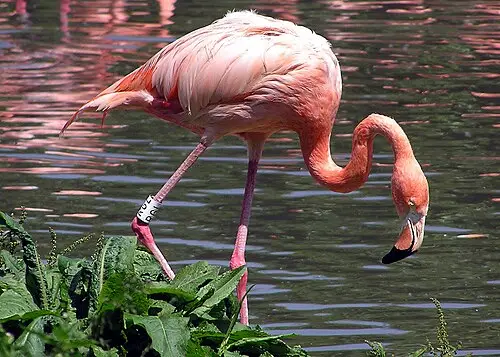
 📸 Photo
Photo: Adrian Pingstone · Public domain · Wikimedia Commons Source
American Flamingo
Phoenicopterus ruber (American Flamingo · ベニイロフラミンゴ)
💡 Everyday Comparisons for Size, Mass & Speed
- 💡 Its height of about 1.5 m is similar to that of an upper-grade elementary school child, and its maximum weight of 4.1 kg is about the same as a 4 kg bag of rice (Comparison).
- 💡 In some regions, its meat and eggs are sold at markets; because the pink color fades over time, its feathers have not become a trade commodity (Animal Diversity Web).
Reference standards: coach bus ~12 m, mid-size car ~4.9 m, compact car ~1 t, basketball hoop 3.05 m, credit card 8.56 cm.
Site-computed relative index from recorded values; not a formal scientific metric.
📖 1. Overview
The American Flamingo is a large pink bird living in flocks of thousands in shallow salt waters of the Caribbean and the northern coast of South America.
🦴 2. Anatomy & Morphology
Its plumage is pink with black flight feathers along the wing edges, and relative to its body size its legs and neck are the longest of any bird. Its bill bends downward and filters food with comb-like plates inside.
🔍 3. Ecology & Behavior
After stirring up bottom mud with its long legs, it dips its head upside down to pump out and filter water with its bill to eat tiny organisms. It breeds in large colonies and builds mound nests of mud.
🇰🇷 4. Connection to Korea
No direct record connecting this species to Korea has been found.
📚 Sources & References
- • IUCN Red List LC (2021) — https://www.iucnredlist.org/species/22729706/138951737
- • IUCN Red List category LC — latest assessment at iucnredlist.org
- • doi.org — avilist.v2026
- • iucnredlist.org — 138951737
- • wikidata.org — Q208004
- • commons.wikimedia.org — File:Caribbean Flamingo.jpg
- • animaldiversity.org — Phoenicopterus ruber
- • nationalzoo.si.edu — american-flamingo
- • Silhouette: PhyloPic — Kai Caspar · CC0 1.0
Recorded dimensions are widely cited representative estimates from public literature and may vary by study or specimen.