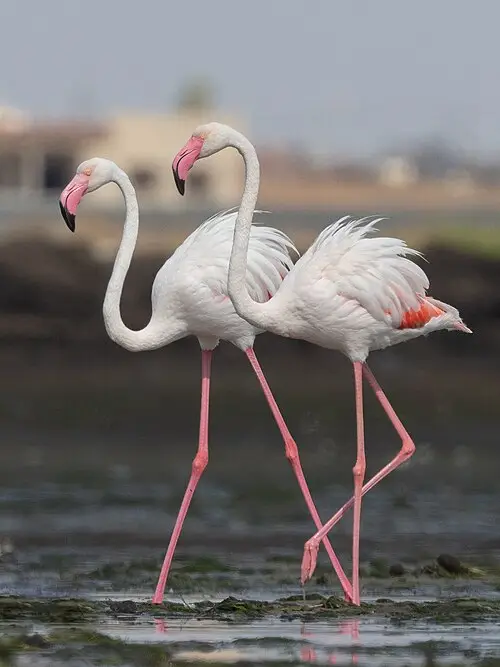
 📸 Photo
Photo: El Golli Mohamed · CC BY-SA 4.0 · Wikimedia Commons Source
Greater Flamingo
Phoenicopterus roseus (Greater Flamingo · オオフラミンゴ)
💡 Everyday Comparisons for Size, Mass & Speed
- 💡 It is also seen near sewage treatment plants, rice paddies, salt pans, and low islands, and sometimes damages rice paddies (ADW).
- 💡 In zoos, if its diet lacks carotenoids, its plumage fails to keep its proper pink color (ADW).
- 💡 The maximum adult weight of 3 kg is similar to two 1.5 L bottles of water (Comparison).
Reference standards: coach bus ~12 m, mid-size car ~4.9 m, compact car ~1 t, basketball hoop 3.05 m, credit card 8.56 cm.
Site-computed relative index from recorded values; not a formal scientific metric.
📖 1. Overview
The Greater Flamingo is a large waterbird living mainly in the Middle East and Southwest Asia as well as parts of Africa and Europe, inhabiting shallow waters with very high salinity or strong alkalinity.
🦴 2. Anatomy & Morphology
Equipped with a filtering and pumping mechanism in its shallowly bent bill, it is the most sophisticated filter feeder among birds. It puts its head upside down in the water and uses its long neck and bill to dig up mud and filter out food.
🔍 3. Ecology & Behavior
It filters algae, diatoms, crustaceans, insect larvae, and mollusks from the mud and also eats brine shrimp, with algal pigments in its diet maintaining its pink plumage. Depending on the region, it also eats rice in paddies.
🇰🇷 4. Connection to Korea
No direct record connecting this species to Korea has been found.
📚 Sources & References
- • IUCN Red List LC (2019) — https://www.iucnredlist.org/species/22697360/155527405
- • IUCN Red List category LC — latest assessment at iucnredlist.org
- • doi.org — avilist.v2026
- • iucnredlist.org — 155527405
- • wikidata.org — Q179863
- • commons.wikimedia.org — File:Flamant rose Thyna009.jpg
- • animaldiversity.org — Phoenicopterus roseus
- • Silhouette: PhyloPic — Ferran Sayol · CC0 1.0
Recorded dimensions are widely cited representative estimates from public literature and may vary by study or specimen.