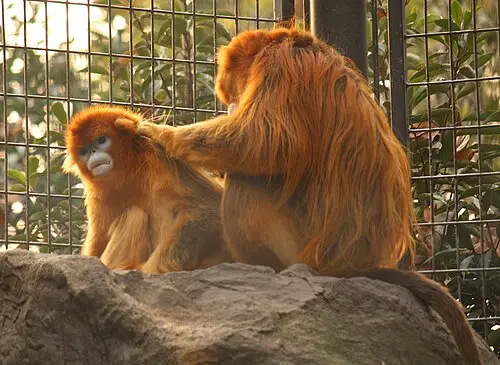
 📸 Photo
Photo: J. Patrick Fischer · CC BY-SA 3.0 · Wikimedia Commons Source
Golden Snub-nosed Monkey
Rhinopithecus roxellana (Golden Snub-nosed Monkey · キンシコウ)
💡 Everyday Comparisons for Size, Mass & Speed
- 💡 Its maximum head-and-body length of 76 cm is slightly shorter than a full-length umbrella (Comparison).
- 💡 A summer band of up to 600 individuals is about the size of a large middle school's student body, an extraordinarily large group among non-human primates (Comparison).
- 💡 It has been hunted for its fur, sold for medicinal use, and its meat, sold for food (Animal Diversity Web).
Reference standards: coach bus ~12 m, mid-size car ~4.9 m, compact car ~1 t, basketball hoop 3.05 m, credit card 8.56 cm.
📖 1. Overview
The Golden Snub-nosed Monkey is a monkey living in temperate mountain forests of China, one of the few primates that inhabit cold regions.
🦴 2. Anatomy & Morphology
Its belly, forehead, and neck are golden, while males have grayish-black fur on the nape, shoulders, back, arms, and tail. Its nose is flattened and upturned with forward-facing nostrils.
🔍 3. Ecology & Behavior
In warm seasons it eats broadleaf tree leaves as well as fir and pine needles, and in winter it subsists on bark and lichens. In summer it forms huge bands of up to 600 individuals, splitting into smaller groups of 60–70 when cold weather arrives.
🇰🇷 4. Connection to Korea
No direct record connecting this species to Korea has been found.
📚 Sources & References
- • IUCN Red List EN (2021) — https://www.iucnredlist.org/species/19596/196491153
- • IUCN Red List category EN — latest assessment at iucnredlist.org
- • mammaldiversity.org — 1000685
- • iucnredlist.org — 196491153
- • wikidata.org — Q756080
- • commons.wikimedia.org — File:2011 Rhinopithecus roxellana.JPG
- • animaldiversity.org — Rhinopithecus roxellana
- • Silhouette: PhyloPic — Yan Wong from drawing by Joseph Smit · CC0 1.0
Recorded dimensions are widely cited representative estimates from public literature and may vary by study or specimen.