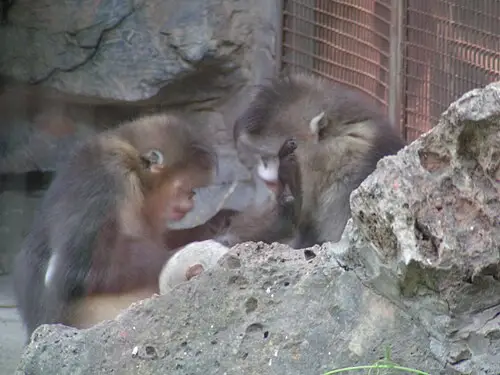
 📸 Photo
Photo: Dreline · CC BY-SA 3.0 · Wikimedia Commons Source
Yunnan Snub-nosed Monkey
Rhinopithecus bieti (Yunnan Snub-nosed Monkey · ウンナンシシバナザル)
💡 Everyday Comparisons for Size, Mass & Speed
- 💡 A male's maximum weight of 17 kg is about 85% of a 20 kg bag of rice (Comparison).
- 💡 Its head-and-body length of 83 cm is slightly longer than the height of a standard desk (about 70–75 cm) (Comparison).
- 💡 In the past, it was hunted for food, medicine, and income (Animal Diversity Web).
Reference standards: coach bus ~12 m, mid-size car ~4.9 m, compact car ~1 t, basketball hoop 3.05 m, credit card 8.56 cm.
Site-computed relative index from recorded values; not a formal scientific metric.
📖 1. Overview
The Yunnan Snub-nosed Monkey is one of the northernmost and highest-living monkeys, inhabiting mountain coniferous forests above 2,600 m in elevation.
🦴 2. Anatomy & Morphology
It shows the greatest size difference between sexes among snub-nosed monkeys, with males 50% larger than females, and has thick lips and sunken nostrils. It is the only black-and-white snub-nosed monkey with long hair, and males have a dark crown crest that droops forward.
🔍 3. Ecology & Behavior
It eats young leaves in spring, fruit in summer and autumn, and lichens in winter, and has also been recorded digging up mushrooms and tubers or eating rodents and bird eggs. Bands gather up to 480 individuals, splitting into smaller units and merging again according to food availability.
🇰🇷 4. Connection to Korea
No direct record connecting this species to Korea has been found.
📚 Sources & References
- • IUCN Red List EN (2020) — https://www.iucnredlist.org/species/19597/17943738
- • IUCN Red List category EN — latest assessment at iucnredlist.org
- • mammaldiversity.org — 1000683
- • iucnredlist.org — 17943738
- • wikidata.org — Q1204873
- • commons.wikimedia.org — File:RhinopitecusBieti.jpg
- • animaldiversity.org — Rhinopithecus bieti
- • Silhouette: PhyloPic — Yan Wong from drawing by Joseph Smit · CC0 1.0 (Congeneric silhouette — Rhinopithecus roxellana)
Recorded dimensions are widely cited representative estimates from public literature and may vary by study or specimen.