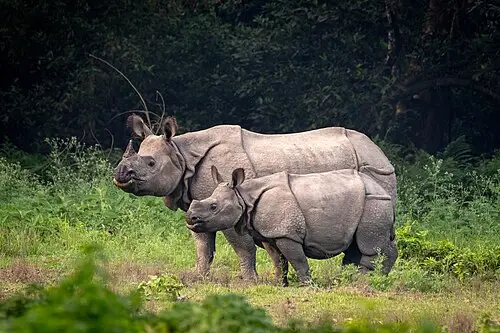
 📸 Photo
Photo: Aditya Pal · CC BY-SA 4.0 · Wikimedia Commons Source
Greater One-horned Rhinoceros
Rhinoceros unicornis (Greater One-horned Rhinoceros · インドサイ)
💡 Everyday Comparisons for Size, Mass & Speed
- 💡 The 150–200 kg it eats in a day equals the weight of seven or eight to ten 20 kg bags of rice (Comparison).
- 💡 The price of its horn jumped from $35 per kg in 1972 to about $18,000 in 1991. Ground horn was used in traditional medicine, and horns were also carved into ceremonial dagger handles and figurines.
- 💡 There are also records of tamed individuals pulling plows, performing tricks in circuses, and carrying loads.
Reference standards: coach bus ~12 m, mid-size car ~4.9 m, compact car ~1 t, basketball hoop 3.05 m, credit card 8.56 cm.
Site-computed relative index from recorded values; not a formal scientific metric.
📖 1. Overview
The Greater One-horned Rhinoceros is a large single-horned rhinoceros living in riverside grasslands of Nepal and northeastern India.
🦴 2. Anatomy & Morphology
Its gray-brown skin has deep folds around the legs and rump that make it look armor-plated. Unlike African rhinos, it has only a single horn, and males have large neck folds.
🔍 3. Ecology & Behavior
A grazer that needs 150–200 kg of food a day, it feeds on grass in the early morning, late afternoon, and night, and also eats flowers, fruits, twigs, and grains such as rice. Outside the breeding season, it usually lives alone.
🇰🇷 4. Connection to Korea
No direct record connecting this species to Korea has been found.
📚 Sources & References
- • IUCN Red List VU (2019) — https://www.iucnredlist.org/species/19496/18494149
- • IUCN Red List category VU — latest assessment at iucnredlist.org
- • mammaldiversity.org — 1006115
- • iucnredlist.org — 18494149
- • wikidata.org — Q47910
- • commons.wikimedia.org — File:Greater one-horned rhinoceros at Chitwan.jpg
- • animaldiversity.org — Rhinoceros unicornis
- • Silhouette: PhyloPic — H. F. O. March (vectorized by T. Michael Keesey) · Public Domain Mark 1.0
Recorded dimensions are widely cited representative estimates from public literature and may vary by study or specimen.