 📸 Photo
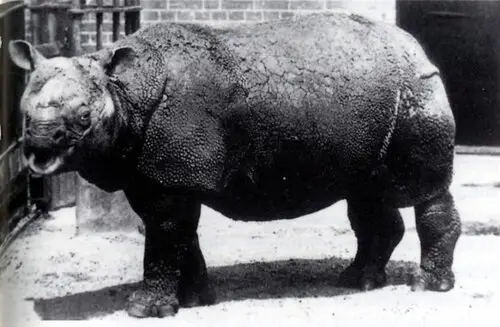
Photo: T.Dixon. The Zoological Society of London · Public domain · Wikimedia Commons Source
Lesser One-horned Rhinoceros
Rhinoceros sondaicus (Lesser One-horned Rhinoceros · ジャワサイ)
💡 Everyday Comparisons for Size, Mass & Speed
- 💡 Its maximum weight of 2 tons is heavier than a passenger car (about 1.5 tons) (Comparison).
- 💡 Its horn has been coveted across many cultures—used as a fever reducer in Chinese medicine, as an aphrodisiac in India, and as a poison detector—though no actual medical value has ever been confirmed.
Reference standards: coach bus ~12 m, mid-size car ~4.9 m, compact car ~1 t, basketball hoop 3.05 m, credit card 8.56 cm.
Site-computed relative index from recorded values; not a formal scientific metric.
📖 1. Overview
The Lesser One-horned Rhinoceros is a small single-horned rhinoceros that lives alone in tropical lowland forests.
🦴 2. Anatomy & Morphology
Its gray skin folds into rigid creases along the shoulders, back, and rump, dividing the hide into sections. Only adult males have a horn of about 25 cm, while females have none, and the horn is not attached to the skull bone.
🔍 3. Ecology & Behavior
Rather than eating grass, it feeds on soft leaves, plants such as figs, and sometimes bamboo, bending and pulling down tall plants to reach them. It spends most of the day wallowing in mud holes.
🇰🇷 4. Connection to Korea
No direct record connecting this species to Korea has been found.
📚 Sources & References
- • IUCN Red List CR (2020) — https://www.iucnredlist.org/species/19495/18493900
- • IUCN Red List category CR — latest assessment at iucnredlist.org
- • mammaldiversity.org — 1006114
- • iucnredlist.org — 18493900
- • wikidata.org — Q170311
- • commons.wikimedia.org — File:Rhinoceros sondaicus in London Zoo.jpg
- • animaldiversity.org — Rhinoceros sondaicus
- • Silhouette: PhyloPic — H. F. O. March (vectorized by T. Michael Keesey) · Public Domain Mark 1.0 (Congeneric silhouette — Rhinoceros unicornis)
Recorded dimensions are widely cited representative estimates from public literature and may vary by study or specimen.