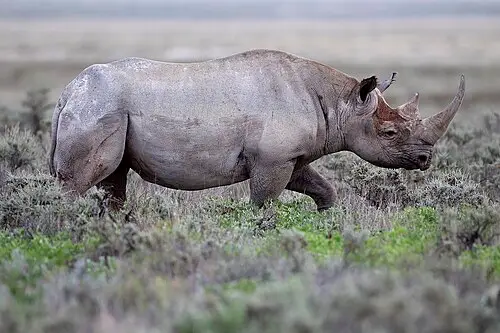
 📸 Photo
Photo: Yathin S Krishnappa · CC BY-SA 3.0 · Wikimedia Commons Source
Black Rhinoceros
Diceros bicornis (Black Rhinoceros · クロサイ)
💡 Everyday Comparisons for Size, Mass & Speed
- 💡 Its horn is used in traditional Chinese medicine and for Yemeni dagger handles, driving heavy poaching; horns are sometimes deliberately trimmed to deter poachers.
- 💡 Its maximum adult weight of 1,400 kg is about the weight of a passenger car (Comparison).
- 💡 Its maximum shoulder height of 1.8 m is similar to the height of an adult human (Comparison).
Reference standards: coach bus ~12 m, mid-size car ~4.9 m, compact car ~1 t, basketball hoop 3.05 m, credit card 8.56 cm.
Site-computed relative index from recorded values; not a formal scientific metric.
📖 1. Overview
The Black Rhinoceros is a two-horned rhinoceros of Africa that now survives only in scattered regions.
🦴 2. Anatomy & Morphology
Its pointed, prehensile upper lip grasps and bends branches to feed, and its two horns are made of keratin. The front horn measures 42–128 cm and the rear horn 20–50 cm.
🔍 3. Ecology & Behavior
It browses on twigs, shrubs, and saplings such as acacia, eating an average of about 23.6 kg per day. After a gestation period of about 15 months, females usually give birth to a single calf.
🇰🇷 4. Connection to Korea
No direct record connecting this species to Korea has been found.
📚 Sources & References
- • IUCN Red List CR (2020) — https://www.iucnredlist.org/species/6557/152728945
- • IUCN Red List category CR — latest assessment at iucnredlist.org
- • mammaldiversity.org — 1006113
- • iucnredlist.org — 152728945
- • wikidata.org — Q95036
- • commons.wikimedia.org — File:2012 Black Rhinoceros Gemsbokvlakte.jpg
- • animaldiversity.org — Diceros bicornis
- • Silhouette: PhyloPic — An Ignorant Atheist · CC0 1.0
Recorded dimensions are widely cited representative estimates from public literature and may vary by study or specimen.