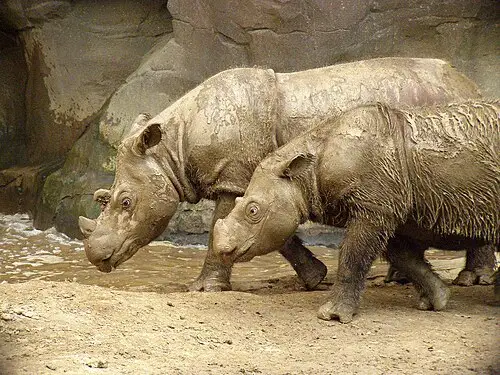
 📸 Photo
Photo: Charles W. Hardin · CC BY 2.0 · Wikimedia Commons Source
Sumatran Rhinoceros
Dicerorhinus sumatrensis (Sumatran Rhinoceros · スマトラサイ)
💡 Everyday Comparisons for Size, Mass & Speed
- 💡 Its speed of 40 km/h is comparable to a car driving on a city street (Comparison).
- 💡 Hunted for centuries, its horn was used in traditional medicine for fevers and strokes and as an aphrodisiac, fetching up to 50,000 USD per kg on the black market.
Reference standards: coach bus ~12 m, mid-size car ~4.9 m, compact car ~1 t, basketball hoop 3.05 m, credit card 8.56 cm.
Site-computed relative index from recorded values; not a formal scientific metric.
📖 1. Overview
The Sumatran Rhinoceros is the smallest and hairiest species of rhinoceros, living in the forests of Southeast Asia.
🦴 2. Anatomy & Morphology
Its body is covered in long hair over reddish-brown skin, with fringed ears and wrinkles around the eyes. It has two horns; in males, the front horn is 25–80 cm and the rear horn is 10 cm or less. Its hair holds mud on the body to help keep it cool.
🔍 3. Ecology & Behavior
A browsing herbivore, it feeds on leaves and twigs of saplings, shrubs, and herbs. Fast and quiet for its size, it lives alone and wallows in mud pits in hot weather to regulate body temperature and ward off insects.
🇰🇷 4. Connection to Korea
No direct record connecting this species to Korea has been found.
📚 Sources & References
- • IUCN Red List CR (2020) — https://www.iucnredlist.org/species/6553/18493355
- • IUCN Red List category CR — latest assessment at iucnredlist.org
- • mammaldiversity.org — 1006112
- • iucnredlist.org — 18493355
- • wikidata.org — Q29220
- • commons.wikimedia.org — File:Sumatran Rhino 2.jpg
- • animaldiversity.org — Dicerorhinus sumatrensis
- • Silhouette: PhyloPic — Christophe Mallet · CC0 1.0
Recorded dimensions are widely cited representative estimates from public literature and may vary by study or specimen.