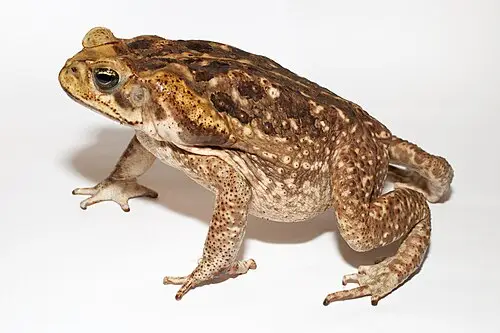
 📸 Photo
Photo: brian.gratwicke · CC BY 2.0 · Wikimedia Commons Source
Cane Toad
Rhinella marina (Cane Toad · オオヒキガエル)
💡 Everyday Comparisons for Size, Mass & Speed
- 💡 Its maximum length of 238 mm equals nine Korean 500-won coins (26.5 mm in diameter) lined up side by side (238.5 mm), and its average weight of 106 g is about 14 Korean 500-won coins (7.7 g) (Comparison).
- 💡 Its toxic secretion can cause drooling, vomiting, breathing difficulty, paralysis, and even death in predators such as dogs, and records of it eating dog and cat food show that it also lives close to human settlements (ADW).
Reference standards: coach bus ~12 m, mid-size car ~4.9 m, compact car ~1 t, basketball hoop 3.05 m, credit card 8.56 cm.
Site-computed relative index from recorded values; not a formal scientific metric.
📖 1. Overview
The Cane Toad is a very large toad living in tropical forests near water and secreting toxic fluid from large glands on its body.
🦴 2. Anatomy & Morphology
Its body length is usually 150–175 mm and reaches up to 238 mm. Its gray-brown olive back is covered with wart-like tubercles, huge parotoid glands stretching from behind the eyes to mid-back, and high bony ridges between the nostrils.
🔍 3. Ecology & Behavior
At night it mainly eats insects such as ants, beetles, and earwigs, though dragonflies, crustaceans, snails, plant matter, and even dog and cat food have been found in its stomach. When threatened it secretes white toxic fluid, and it breeds nearly year-round, laying more than 30,000 eggs at a time in jelly-like strings.
🇰🇷 4. Connection to Korea
No direct record connecting this species to Korea has been found.
📚 Sources & References
- • IUCN Red List LC (2023) — https://www.iucnredlist.org/species/100099625/2951416
- • IUCN Red List category LC — latest assessment at iucnredlist.org
- • catalogueoflife.org — 4S7NY
- • iucnredlist.org — 2951416
- • wikidata.org — Q321087
- • animaldiversity.org — Rhinella marina
- • bok.or.kr — contents.do
- • Silhouette: PhyloPic — Dennis C. Murphy, after http://bit.ly/4q6IESe · CC0 1.0
Recorded dimensions are widely cited representative estimates from public literature and may vary by study or specimen.