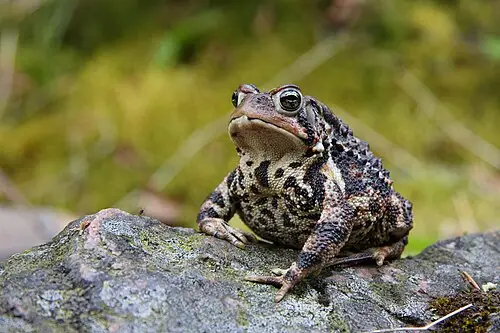
 📸 Photo
Photo: Cephas · CC BY-SA 3.0 · Wikimedia Commons Source
American Toad
Anaxyrus americanus (American Toad · アメリカヒキガエル)
💡 Everyday Comparisons for Size, Mass & Speed
- 💡 An average body length of 75 mm is similar to the length of three Korean 500-won coins (diameter 26.5 mm) lined up side by side (79.5 mm) (Comparison).
- 💡 Because it can eat up to 1,000 insects a day, it is regarded as a friend to gardeners and farmers (ADW).
Reference standards: coach bus ~12 m, mid-size car ~4.9 m, compact car ~1 t, basketball hoop 3.05 m, credit card 8.56 cm.
📖 1. Overview
The American Toad is a toad living almost everywhere in North America from forests to backyards. It needs semi-permanent freshwater ponds to breed.
🦴 2. Anatomy & Morphology
It has short legs, a plump body, and thick skin with prominent wart-like bumps. Its body length is 50–102 mm (averaging 75 mm), and its skin is usually brown but shifts from yellow to brown to black depending on temperature, humidity, and stress. The milky poison from its skin glands is harmful only if swallowed or if it gets in the eyes.
🔍 3. Ecology & Behavior
Adults eat insects, snails, slugs, and earthworms; unusually for a toad, it shoots out a sticky tongue to catch prey and can eat up to 1,000 insects a day. It breeds in months 3–7, with males arriving first to establish territories and call to females.
🇰🇷 4. Connection to Korea
No direct record connecting this species to Korea has been found.
📚 Sources & References
- • IUCN Red List LC (2022) — https://www.iucnredlist.org/species/54570/193225406
- • IUCN Red List category LC — latest assessment at iucnredlist.org
- • catalogueoflife.org — 66LTT
- • iucnredlist.org — 193225406
- • wikidata.org — Q694496
- • commons.wikimedia.org — File:Bufo americanus PJC1.jpg
- • animaldiversity.org — Anaxyrus americanus
- • bok.or.kr — contents.do
- • Silhouette: PhyloPic — Michael Scroggie, from original photograph by Gary M. Stolz, USFWS (original photograph in public domain). · CC0 1.0 (Congeneric silhouette — Anaxyrus woodhousii)
Recorded dimensions are widely cited representative estimates from public literature and may vary by study or specimen.