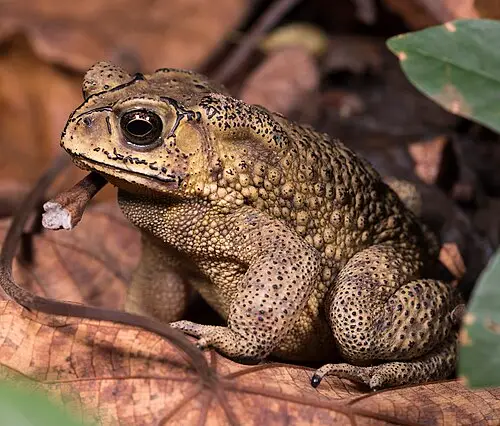
 📸 Photo
Photo: LiCheng Shih · CC BY 2.0 · Wikimedia Commons Source
Asian Common Toad
Duttaphrynus melanostictus (Asian Common Toad · ヘリグロヒキガエル)
💡 Everyday Comparisons for Size, Mass & Speed
- 💡 The female maximum length of 85 mm is slightly longer than three Korean 500-won coins (26.5 mm in diameter) lined up side by side (79.5 mm) (Comparison).
- 💡 During the day it hides in drains, garbage piles, and houses, and it helps agriculture by eating insect pests on farms in India (ADW).
Reference standards: coach bus ~12 m, mid-size car ~4.9 m, compact car ~1 t, basketball hoop 3.05 m, credit card 8.56 cm.
📖 1. Overview
The Asian Common Toad is a widespread toad living in subtropical and tropical regions of Asia, thriving everywhere from forest edges to gardens, farmland, and cities.
🦴 2. Anatomy & Morphology
It is a stocky medium-to-large toad with thick, dry skin, prominent cranial ridges, and protruding parotoid glands behind the ears. Snout-to-vent length is 57–83 mm in males and 65–85 mm in females, and body color varies widely from brick red to nearly black.
🔍 3. Ecology & Behavior
A nocturnal insect predator, it opportunistically eats a variety of arthropods—such as beetles, ants, termites, and bees—as well as mollusks. Breeding depends on water and takes place at the start of the rainy season, when females lay long strings of black eggs attached to aquatic plants.
🇰🇷 4. Connection to Korea
No direct record connecting this species to Korea has been found.
📚 Sources & References
- • IUCN Red List LC (2023) — https://www.iucnredlist.org/species/54707/53714486
- • IUCN Red List category LC — latest assessment at iucnredlist.org
- • catalogueoflife.org — 6DQ3T
- • iucnredlist.org — 53714486
- • wikidata.org — Q28031739
- • commons.wikimedia.org — File:Duttaphrynus melanostictus at Niaosong Wetland Park, Ka
- • animaldiversity.org — Duttaphrynus melanostictus
- • bok.or.kr — contents.do
- • Silhouette: PhyloPic — Vijay Karthick · CC0 1.0 (Congeneric silhouette — Duttaphrynus)
Recorded dimensions are widely cited representative estimates from public literature and may vary by study or specimen.