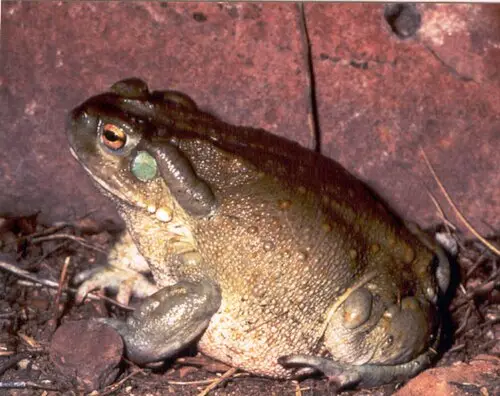
 📸 Photo
Photo: Public domain · Public domain · Wikimedia Commons Source
Sonoran Desert Toad
Incilius alvarius (Sonoran Desert Toad · コロラドリバーヒキガエル)
💡 Everyday Comparisons for Size, Mass & Speed
- 💡 Its maximum length of 187 mm is nearly equal to seven Korean 500-won coins (26.5 mm in diameter) lined up side by side (185.5 mm) (Comparison).
- 💡 The toxin it releases when disturbed can affect animals as large as dogs, causing paralysis or even death, and it eats crop pests such as snails (ADW).
Reference standards: coach bus ~12 m, mid-size car ~4.9 m, compact car ~1 t, basketball hoop 3.05 m, credit card 8.56 cm.
📖 1. Overview
The Sonoran Desert Toad is a very large toad living near large streams in deserts and semi-arid regions, staying closer to water than most toads.
🦴 2. Anatomy & Morphology
A very large toad measuring 110–187 mm in body length, it has dark olive-green leathery skin, cranial crests, elongated parotoid glands, and raised tubercles on the hind legs.
🔍 3. Ecology & Behavior
It preys on snails, beetles, spiders, grasshoppers, lizards, mice, and even smaller toads, catching prey with a long, sticky tongue. Active at night, it gathers in temporary pools formed after summer showers to breed, and when disturbed it secretes a toxin that irritates predators' mucous membranes.
🇰🇷 4. Connection to Korea
No direct record connecting this species to Korea has been found.
📚 Sources & References
- • IUCN Red List LC (2022) — https://www.iucnredlist.org/species/54567/53948448
- • IUCN Red List category LC — latest assessment at iucnredlist.org
- • catalogueoflife.org — 3PLBX
- • iucnredlist.org — 53948448
- • wikidata.org — Q10534901
- • commons.wikimedia.org — File:Bufo alvarius1.jpg
- • animaldiversity.org — Incilius alvarius
- • bok.or.kr — contents.do
- • Silhouette: PhyloPic — Jose Carlos Arenas-Monroy · CC0 1.0 (Congeneric silhouette — Incilius valliceps)
Recorded dimensions are widely cited representative estimates from public literature and may vary by study or specimen.