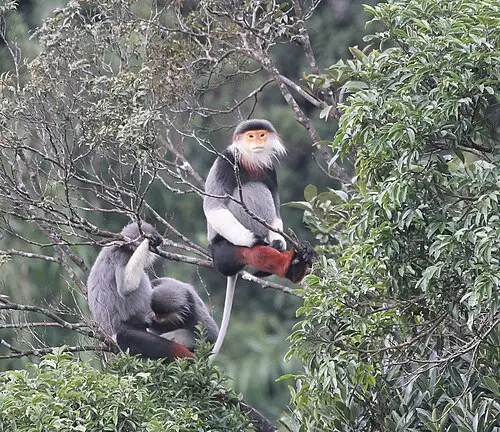
 📸 Photo
Photo: Abby Darrah · CC BY 4.0 · Wikimedia Commons Source
Red-shanked Douc
Pygathrix nemaeus (Red-shanked Douc · アカアシドゥクラングール)
💡 Everyday Comparisons for Size, Mass & Speed
- 💡 A male's average weight of 10.9 kg is about five and a half 2 L bottles of water (Comparison).
- 💡 Unlike humans who must drink water every day, it gets all the moisture it needs from leaves and fruits without drinking water separately.
- 💡 Some are captured for the pet trade and some are hunted for food (Animal Diversity Web).
Reference standards: coach bus ~12 m, mid-size car ~4.9 m, compact car ~1 t, basketball hoop 3.05 m, credit card 8.56 cm.
Site-computed relative index from recorded values; not a formal scientific metric.
📖 1. Overview
The Red-shanked Douc is a leaf-eating monkey living in Southeast Asian forests, called the "costumed ape" for its colorful coat.
🦴 2. Anatomy & Morphology
It has a gray body, a white tail, and a pot-bellied build. This subspecies has black hind legs that look as if they are wearing maroon "leg warmers" from knee to ankle, and its forearms are white from elbow to wrist.
🔍 3. Ecology & Behavior
Leaves make up about 82% of its diet, along with unripe fruits and flowers, and it gets its water from its food without drinking separately. Active by day in the trees, it usually forms groups of 4–15 individuals.
🇰🇷 4. Connection to Korea
No direct record connecting this species to Korea has been found.
📚 Sources & References
- • IUCN Red List CR (2020) — https://www.iucnredlist.org/species/39826/17941247
- • IUCN Red List category CR — latest assessment at iucnredlist.org
- • mammaldiversity.org — 1000680
- • iucnredlist.org — 17941247
- • wikidata.org — Q838944
- • commons.wikimedia.org — File:Pygathrix nemaeus 339167163.jpg
- • animaldiversity.org — Pygathrix nemaeus
- • Silhouette: PhyloPic — An Ignorant Atheist · CC0 1.0 (Related taxon silhouette — Cercopithecinae)
Recorded dimensions are widely cited representative estimates from public literature and may vary by study or specimen.